Application
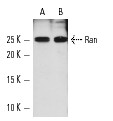
Western blot analysis of Ran expression in phorbol-induced HeLa (A) and A-431 (B) nuclear extracts.| Product Name | Ran Antibody (H-96) |
|---|---|
| Antibody Type | Primary Antibodies |
| Modification Notes | The small Ras-related protein Ran, also called TC4, is a nuclear localized GTPase implicated in a diverse array of cellular processes including DNA replication, entry into and exit from mitosis and the transport of RNA and proteins through the nuclear pore complex. Like Ras, active Ran GTP and inactive Ran GDP levels are tightly regulated by guanine nucleotide exchange factors (GEFs) and GTPase activating proteins (GAPs). The abundant GEF, RCC1 (regulator of chromosome condensation 1), increases the rate at which Ran exchanges GDP for GTP. Ran GAP1 opposes the effects of RCC1 by increasing the rate at which Ran hydrolyzes GTP to GDP. A protein designated Ran BP-1 has no intrinsic GAP activity and functions as a GEF inhibitor deactivating RCC1, thereby indirectly increasing the ratio of Ran GDP to Ran GTP. The protein Ran BP-2 has been proposed as the Ran GTP docking site at the periphery of the nuclear pore complex. |
| Clonality | Polyclonal |
|---|---|
| Isotype | IgG |
| Host Species | Rabbit |
| Tested Applications | WBIPIFELISA |
| recommended for detection of Ran of mouse, rat and human origin by WB, IP, IF and ELISA also reactive with additional species, including equine, canine, bovine, porcine and avian | |
| Species Reactivity | HumanMouseRat |
| Concentration | 1mg/ml |
| Purification | Affinity purified |
| Alternative Names | epitope corresponding to amino acids 121-216 mapping at the C-terminus of Ran of human origin |
|---|---|
| Tissue Specificity | epitope corresponding to amino acids 121-216 mapping at the C-terminus of Ran of human origin |
| Entrez Gene | 5901 |
|---|
Application
Western blot analysis of Ran expression in phorbol-induced HeLa (A) and A-431 (B) nuclear extracts.| Application Notes | recommended for detection of Ran of mouse, rat and human origin by WB, IP, IF and ELISA also reactive with additional species, including equine, canine, bovine, porcine and avian |
|---|
| Form | Liquid |
|---|---|
| Storage Instructions | For short-term storage, store at 4° C. For long-term storage, aliquot and store at -20ºC or below. Avoid multiple freeze-thaw cycles. |
| Storage Buffer | phosphate buffered saline , pH 7.4, 150mM NaCl, 0.02% sodium azide and 50% glycerol. |


