Application
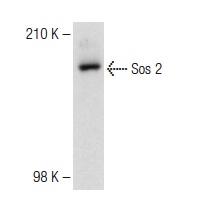
Western blot analysis of Sos 2 expression in J774.A1 whole cell lysate.Application
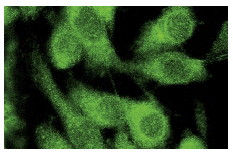
Immunofluorescence staining of methanol-fixed SK-MEL-28 cells showing cytoplasmic localization.| Product Name | Sos 2 Antibody (H-80) |
|---|---|
| Antibody Type | Primary Antibodies |
| Modification Notes | The superfamily of GTP-binding proteins, of which Ras proteins are prototypes, has been implicated in a broad range of biological activities. Studies have identified a family of guanine nucleotide-releasing factors (GRFs) that activate Ras in mammalian cells and an “adapter” protein (Sem 5/GRB2) that appears to mediate the interaction of GRFs with activated receptor molecules. Ras-GRF p140 promotes nucleotide exchange on Ras p21s but not on other members of the Ras gene superfamily. In addition, three mammalian homologs of the Drosophila Ras-GRF, son of sevenless (Sos), have been described. These include two from mouse, mSos 1 and mSos 2, and one from human, hSos. Vav p95 has been reported to function as a GRF in activation of Ras by the T cell receptor and has been reported to have a domain similar to that of Dbl p115, which is a GRF specific for Cdc42Hs. Subsequent to activation, Ras appears to interact with Raf, thereby activating the MAP kinase phosphorylation pathway. |
| Clonality | Polyclonal |
|---|---|
| Isotype | IgG |
| Host Species | Rabbit |
| Tested Applications | WBIPIFELISA |
| recommended for detection of Sos 2 p155 of mouse, rat and human origin by WB, IP, IF and ELISA also reactive with additional species, including equine, canine and bovine | |
| Species Reactivity | HumanMouseRat |
| Concentration | 1mg/ml |
| Purification | Affinity purified |
| Alternative Names | epitope corresponding to amino acids 1091-1170 mapping near the C-terminus of Sos 2 of human origin |
|---|---|
| Tissue Specificity | epitope corresponding to amino acids 1091-1170 mapping near the C-terminus of Sos 2 of human origin |
| Entrez Gene | 6655 |
|---|
Application
Western blot analysis of Sos 2 expression in J774.A1 whole cell lysate.
Application
Immunofluorescence staining of methanol-fixed SK-MEL-28 cells showing cytoplasmic localization.| Application Notes | recommended for detection of Sos 2 p155 of mouse, rat and human origin by WB, IP, IF and ELISA also reactive with additional species, including equine, canine and bovine |
|---|
| Form | Liquid |
|---|---|
| Storage Instructions | For short-term storage, store at 4° C. For long-term storage, aliquot and store at -20ºC or below. Avoid multiple freeze-thaw cycles. |
| Storage Buffer | phosphate buffered saline , pH 7.4, 150mM NaCl, 0.02% sodium azide and 50% glycerol. |


