Application
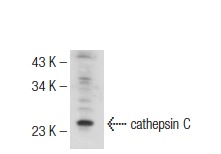
Western blot analysis of cathepsin C expression in M1 whole cell lysate.| Product Name | cathepsin C Antibody (H-144) |
|---|---|
| Antibody Type | Primary Antibodies |
| Antigen Alias | epitope corresponding to amino acids 251-394 mapping to the heavy chain of cathepsin C of human origin |
| Modification Notes | Cathepsin C, known also as dipeptidyl aminopeptidase I (DPPI), is a tetrameric lysosomal cysteine peptidase belonging to the papain family (1). Cathepsin C is involved in intracellular protein degradation and the processing of protein precursors, where it participates in cell growth, neuraminidase activation, and platelet factor XIII activation (2,3). Cathepsin C is largely related to other lysosomal cysteine proteinases, including cathepsin B, H and L (4). Enzymatically, Cathepsin C is capable of sequentially removing dipeptides from the amino terminus, and it requires halide ions, namely chloride ions, and thiols for complete enzymatic activity (5,6). Protein levels of Cathepsin C are detected in a variety of tissues, and it is most highly expressed in spleen, kidney, cytotoxic lymphocytes and myeloid cells, where it localizes to the secretory granule compartment (7). Cathepsin C is initially synthesized as a proenzyme that is rapidly processed to generate two distinct chains that function together as the mature form of the enzyme (8). |
| Clonality | Polyclonal |
|---|---|
| Isotype | IgG |
| Host Species | Rabbit |
| Tested Applications | WBIPIFELISA |
| recommended for detection of cathepsin C of mouse, rat and human origin by WB, IP, IF and ELISA also reactive with additional species, including equine, canine, bovine and porcine: |
|
| Species Reactivity | HumanMouseRat |
| Concentration | 1mg/ml |
| Purification | Affinity purified |
| Alternative Names | epitope corresponding to amino acids 251-394 mapping to the heavy chain of cathepsin C of human origin |
|---|---|
| Tissue Specificity | epitope corresponding to amino acids 251-394 mapping to the heavy chain of cathepsin C of human origin |
| Entrez Gene | 1075 |
|---|
Application
Western blot analysis of cathepsin C expression in M1 whole cell lysate.| Application Notes | recommended for detection of cathepsin C of mouse, rat and human origin by WB, IP, IF and ELISA also reactive with additional species, including equine, canine, bovine and porcine: |
|---|
| Form | Liquid |
|---|---|
| Storage Instructions | For short-term storage, store at 4° C. For long-term storage, aliquot and store at -20ºC or below. Avoid multiple freeze-thaw cycles. |
| Storage Buffer | phosphate buffered saline , pH 7.4, 150mM NaCl, 0.02% sodium azide and 50% glycerol. |


