Application
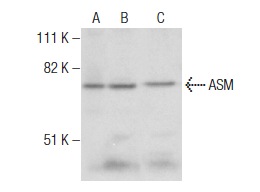
Western blot analysis of ASM expression in CCD-1064Sk (A), CCRF-CEM (B) and A2058 (C) whole cell lysates.Application
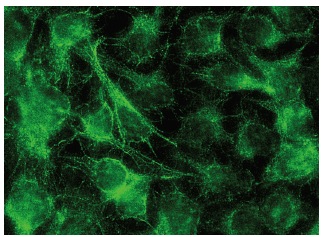
Immunofluorescence staining of methanol-fixed HeLa cells showing membrane and cytoplasmic localization.| Product Name | ASM Antibody (H-181) AC |
|---|---|
| Antibody Type | Primary Antibodies |
| Antigen Alias | epitope corresponding to amino acids 1-181 mapping at the N-terminus of ASM of human origin |
| Modification Notes | Acid sphingomyelinase (ASM) is a lysosomal protein that hydrolyzes sphingomyelin to ceramide and phosphocholine. The ASM gene encodes three proteins, ASM-1, ASM-2 and ASM-3, of which ASM-1 is the only ASM gene product that is a catalytically active enzyme. Deficiency of ASM is associated with type A and type B Niemann-Pick disease. Type A is a fatal neurodegenerative disorder seen in infancy and resulting in death by age three, whereas type B is a non-neuropathic disease that has a later onset. During monocytic cell differentiation, the expression of ASM is upregulated by the combined actions of AP-2 and Sp1 transcription factors. |
| Clonality | Polyclonal |
|---|---|
| Isotype | IgG |
| Host Species | Rabbit |
| Tested Applications | WBIPIFELISA |
| recommended for detection of ASM of mouse, rat and human origin by WB, IP, IF and ELISA: |
|
| Species Reactivity | HumanMouseRat |
| Concentration | 1mg/ml |
| Purification | Affinity purified |
| Alternative Names | epitope corresponding to amino acids 1-181 mapping at the N-terminus of ASM of human origin |
|---|---|
| Tissue Specificity | epitope corresponding to amino acids 1-181 mapping at the N-terminus of ASM of human origin |
| Entrez Gene | 6609 |
|---|
Application
Western blot analysis of ASM expression in CCD-1064Sk (A), CCRF-CEM (B) and A2058 (C) whole cell lysates.
Application
Immunofluorescence staining of methanol-fixed HeLa cells showing membrane and cytoplasmic localization.| Application Notes | recommended for detection of ASM of mouse, rat and human origin by WB, IP, IF and ELISA: |
|---|
| Form | Liquid |
|---|---|
| Storage Instructions | For short-term storage, store at 4° C. For long-term storage, aliquot and store at -20ºC or below. Avoid multiple freeze-thaw cycles. |
| Storage Buffer | phosphate buffered saline , pH 7.4, 150mM NaCl, 0.02% sodium azide and 50% glycerol. |


