Application
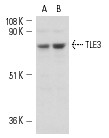
Western blot analysis of TLE3 expression in A-431 (A) and HeLa (B) nuclear extracts.| Product Name | TLE3 Antibody (M-201) |
|---|---|
| Antibody Type | Primary Antibodies |
| Antigen Alias | epitope corresponding to amino acids 200-400 mapping within an internal region of TLE3 of mouse origin |
| Modification Notes | The Notch signaling pathway controls cellular interactions important for the specification of a variety of fates in both invertebrates and vertebrates. Key players in the Notch pathway are the TLE genes (for transducin-like enhancer of split, also designated ESG for enhancer of split groucho), which are human homologs of the Drosophila groucho gene. Groucho is a transcriptional repressor that plays a key role in neurogenesis, segmentation and sex determination. TLEs associate with chromatin in live cells and specifically with Histone H3, but not with other core histones. Expression of the TLE genes, TLE1, TLE2, TLE3 and TLE4, correlate with immature epithelial cells that are progressing toward a terminally differentiated state, suggesting a role during epithelial differentiation. TLE1, TLE2 and TLE3 have elevated expression in cervical squamous metaplasias and carcinomas, while TLE4 is most highly expressed in the brain, particularly in the caudate nucleus. TLE1 and TLE4 contain SP and WD40 domains, through which TLE1 binds AML1 to inhibit AML1-induced transactivation of the CSF1 receptor. In early stages of cell differentiation, TLE1 is upregulated, and TLE2 and TLE4 are downregulated. In later stages, TLE2 and TLE4 are upregulated, and expression of TLE1 decreases. |
| Clonality | Polyclonal |
|---|---|
| Isotype | IgG |
| Host Species | Rabbit |
| Tested Applications | WBIPIFELISAGSChIP |
| recommended for detection of TLE3 and, to a lesser extent, TLE1 and TLE4 of mouse, rat and human origin by WB, IP, IF and ELISA also reactive with additional species, including equine, canine, bovine and porcine: |
|
| Species Reactivity | HumanMouseRat |
| Concentration | 1mg/ml |
| Purification | Affinity purified |
| Alternative Names | epitope corresponding to amino acids 200-400 mapping within an internal region of TLE3 of mouse origin |
|---|---|
| Tissue Specificity | epitope corresponding to amino acids 200-400 mapping within an internal region of TLE3 of mouse origin |
| Entrez Gene | 7090 |
|---|
Application
Western blot analysis of TLE3 expression in A-431 (A) and HeLa (B) nuclear extracts.| Application Notes | recommended for detection of TLE3 and, to a lesser extent, TLE1 and TLE4 of mouse, rat and human origin by WB, IP, IF and ELISA also reactive with additional species, including equine, canine, bovine and porcine: |
|---|
| Form | Liquid |
|---|---|
| Storage Instructions | For short-term storage, store at 4° C. For long-term storage, aliquot and store at -20ºC or below. Avoid multiple freeze-thaw cycles. |
| Storage Buffer | phosphate buffered saline , pH 7.4, 150mM NaCl, 0.02% sodium azide and 50% glycerol. |


