Application
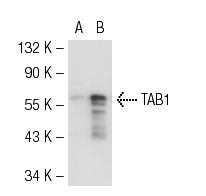
Western blot analysis of TAB1 expression in non-transfected: (A) and mouse TAB1 transfected: (B) 293T whole cell lysates.| Product Name | TAB1 Antibody (H-300) |
|---|---|
| Antibody Type | Primary Antibodies |
| Antigen Alias | epitope corresponding to amino acids 1-300 mapping at the N-terminus of TAB1 (Tak1 binding protein) of human origin |
| Modification Notes | The TAK1 binding proteins, TAB1, TAB2 and TAB3, interact with the MAPKKK TAK1 in response to various stimuli. TAB1 activates TAK1 in TGF∫ mediated signaling. TAB1 also plays a central role in a p38å activation pathway that is independent of MAPKK. In response to proinflammatory signals, TAB2 complexes with TRAF6 and TAK1, leading to translocation of the complex from the membrane to the cytosol and the subsequent activation of TAK1. When overexpressed, TAB3 activates both NFkB and AP-1 transcription factors. In response to TNFå or IL-1, TAK1 complexes with TAB1 and TAB2 or with TAB1 and TAB3 to yield two distinct complexes. |
| Clonality | Polyclonal |
|---|---|
| Isotype | IgG |
| Host Species | Rabbit |
| Tested Applications | WBIPIFELISA |
| recommended for detection of TAB1 of mouse and human origin by WB, IP, IF and ELISA also reactive with additional species, including canine, porcine and avian: |
|
| Species Reactivity | HumanMouseRat |
| Concentration | 1mg/ml |
| Purification | Affinity purified |
| Alternative Names | epitope corresponding to amino acids 1-300 mapping at the N-terminus of TAB1 (Tak1 binding protein) of human origin |
|---|---|
| Tissue Specificity | epitope corresponding to amino acids 1-300 mapping at the N-terminus of TAB1 (Tak1 binding protein) of human origin |
| Entrez Gene | 10454 |
|---|
Application
Western blot analysis of TAB1 expression in non-transfected: (A) and mouse TAB1 transfected: (B) 293T whole cell lysates.| Application Notes | recommended for detection of TAB1 of mouse and human origin by WB, IP, IF and ELISA also reactive with additional species, including canine, porcine and avian: |
|---|
| Form | Liquid |
|---|---|
| Storage Instructions | For short-term storage, store at 4° C. For long-term storage, aliquot and store at -20ºC or below. Avoid multiple freeze-thaw cycles. |
| Storage Buffer | phosphate buffered saline , pH 7.4, 150mM NaCl, 0.02% sodium azide and 50% glycerol. |


