Application
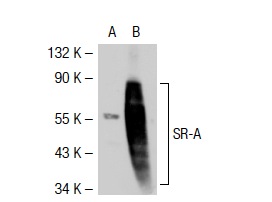
Western blot analysis of SR-A expression in non-transfected: (A) and human SR-A transfected: (B) 293T whole cell lysates.| Product Name | SR-A Antibody (H-190) |
|---|---|
| Antibody Type | Primary Antibodies |
| Antigen Alias | epitope corresponding to amino acids 61-250 mapping near the N-terminus of SR-A of human origin |
| Modification Notes | The macrophage class A scavenger receptor (SR-A) mediates the uptake of modified low density lipoprotein (LDL) (1). The gene encoding human SR-A maps to chromosome 8 and gives rise to two alternatively spliced isoforms, type I and II (SR-AI and SR-AII), which were originally cloned from the phorbol ester-treated human monocytic cell line THP-1 (2). Both isoforms contain six domains: cytoplasmic (I), membrane-spanning (II), spacer (III), alpha-helical coiled-coil (IV), collagen-like (V) and a type-specific C-terminal (VI) (2,3). Domain IV is essential for the trimerization of SR-A, whereas domain V is essential for the wide range of ligand recognition (3). SR-A is expressed in liver, placenta and brain (2). Both SR-AI and SR-AII mediate the uptake of LDLs in atherosclerotic lesions (2). A third isoform, SR-AIII, is unable to uptake LDLs and acts as a dominant negative isoform to possibly protect cells found in advanced atherosclerotic lesions (1,4). SR-A plays a role not only in many macrophage-associated pathological processes, including atherosclerosis and Alzheimer’s disease, but also in host defense and as an adhesion molecule (5,6). |
| Clonality | Polyclonal |
|---|---|
| Isotype | IgG |
| Host Species | Rabbit |
| Tested Applications | WBIPIFELISA |
| recommended for detection of SR-A of human origin by WB, IP, IF and ELISA: |
|
| Species Reactivity | HumanMouseRat |
| Concentration | 1mg/ml |
| Purification | Affinity purified |
| Alternative Names | epitope corresponding to amino acids 61-250 mapping near the N-terminus of SR-A of human origin |
|---|---|
| Tissue Specificity | epitope corresponding to amino acids 61-250 mapping near the N-terminus of SR-A of human origin |
| Entrez Gene | 4481 |
|---|
Application
Western blot analysis of SR-A expression in non-transfected: (A) and human SR-A transfected: (B) 293T whole cell lysates.| Application Notes | recommended for detection of SR-A of human origin by WB, IP, IF and ELISA: |
|---|
| Form | Liquid |
|---|---|
| Storage Instructions | For short-term storage, store at 4° C. For long-term storage, aliquot and store at -20ºC or below. Avoid multiple freeze-thaw cycles. |
| Storage Buffer | phosphate buffered saline , pH 7.4, 150mM NaCl, 0.02% sodium azide and 50% glycerol. |


