Application
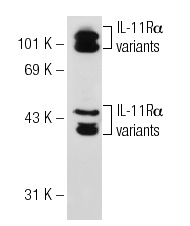
Western blot analysis of IL-11Rα expression in K-562 whole cell lysate.Application
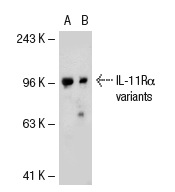
Western blot analysis of IL-11Rα expression in non-transfected: (A) and mouse IL-11Rα transfected: (B) 293T whole cell lysates.| Product Name | IL-11Rα Antibody (H-300) |
|---|---|
| Antibody Type | Primary Antibodies |
| Antigen Alias | epitope corresponding to amino acids 1-300 mapping at the N-terminus of IL-11Rα of human origin |
| Modification Notes | The pleiotropic cytokine, IL-11, has been shown to have proliferative and differentiation effects on lymphopoietic, myeloid and erythroid cells. IL-11 also has the inhibiting effect of repressing adipogenesis in vitro. The IL-11a receptor, IL-11Ra, is a member of the class I subgroup of the cytokine receptor family and exhibits structural similarity to the a subunits of the human ciliary neurotrophic factor (CNTF) and the mouse IL-6 receptor. It is speculated that the IL-11Ra regulates the proliferation and/or differentiation of skeletogenic progenitor and mesenchymal cells. Coexpression of gp130 and IL-11a is necessary for high affinity binding of IL-11 to IL-11Ra. It has also been found that coexpression of IL-11Ra and gp130 is required for proper stimulation of Ba/F3 cells to differentiate into macrophage in response to IL-11. |
| Clonality | Polyclonal |
|---|---|
| Isotype | IgG |
| Host Species | Rabbit |
| Tested Applications | WBIPIFELISA |
| recommended for detection of IL-11Rα of mouse, rat and human origin by WB, IP, IF and ELISA also reactive with additional species, including equine, bovine and porcine: |
|
| Species Reactivity | HumanMouseRat |
| Concentration | 1mg/ml |
| Purification | Affinity purified |
| Alternative Names | epitope corresponding to amino acids 1-300 mapping at the N-terminus of IL-11R&alpha of human origin |
|---|---|
| Tissue Specificity | epitope corresponding to amino acids 1-300 mapping at the N-terminus of IL-11Rα of human origin |
| Entrez Gene | 3590 |
|---|
Application
Western blot analysis of IL-11Rα expression in K-562 whole cell lysate.
Application
Western blot analysis of IL-11Rα expression in non-transfected: (A) and mouse IL-11Rα transfected: (B) 293T whole cell lysates.| Application Notes | recommended for detection of IL-11Rα of mouse, rat and human origin by WB, IP, IF and ELISA also reactive with additional species, including equine, bovine and porcine: |
|---|
| Form | Liquid |
|---|---|
| Storage Instructions | For short-term storage, store at 4° C. For long-term storage, aliquot and store at -20ºC or below. Avoid multiple freeze-thaw cycles. |
| Storage Buffer | phosphate buffered saline , pH 7.4, 150mM NaCl, 0.02% sodium azide and 50% glycerol. |


