Application
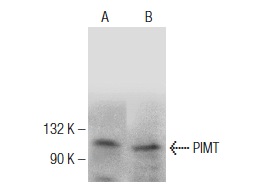
Western blot analysis of PIMT expression in SW480 nuclear extract (A) and rat testis tissue extract (B).| Product Name | PIMT Antibody (H-223) |
|---|---|
| Antibody Type | Primary Antibodies |
| Modification Notes | The PIMT (PRIP-interacting protein with methyltransferase domain) protein binds to the nuclear receptor coactivator PRIP (peroxisome proliferator-activated receptor (PPAR)-interacting protein), enhancing the coactivator function of PRIP. PIMT and PRIP co-localize to the nucleus. PPARg-induced transcription increases irrespective of singular or co-transfection of PIMT and PRIP. PIMT enhances the PBP-mediated transcriptional activity of PPARg and represses the CBP/p300-mediated transactivation of PPARg. PIMT also binds and co-localizes to the nucleus with the transcription activators CBP, p300 and PBP. PIMT may also be a putative RNA methyltransferase, as it binds both the methyl donor for the methyltransfer reaction (S-adenosyl-l-methionine) and RNA. The human PIMT gene maps to chromosome 8q11 and encodes a 852 amino acid protein, which is highly expressed in heart, skeletal muscle, kidney, liver and placenta. The PPARa-interacting cofactor (PRIC) complex comprises PIMT, PRIP, CBP, PBP and more than 20 other coactivators or coactivator-binding proteins. Ciprofibrate and leukotriene B4 both induce PRIC complex-PPARa interaction, which enhances transcription. |
| Clonality | Polyclonal |
|---|---|
| Isotype | IgG |
| Host Species | Rabbit |
| Tested Applications | WBIPIFELISA |
| recommended for detection of PIMT of mouse, rat and human origin by WB, IP, IF and ELISA also reactive with additional species, including canine | |
| Species Reactivity | HumanMouseRat |
| Concentration | 1mg/ml |
| Purification | Affinity purified |
| Alternative Names | epitope corresponding to amino acids 631-853 mapping at the C-terminus of PIMT of human origin |
|---|---|
| Tissue Specificity | epitope corresponding to amino acids 631-853 mapping at the C-terminus of PIMT of human origin |
Application
Western blot analysis of PIMT expression in SW480 nuclear extract (A) and rat testis tissue extract (B).| Application Notes | recommended for detection of PIMT of mouse, rat and human origin by WB, IP, IF and ELISA also reactive with additional species, including canine |
|---|
| Form | Liquid |
|---|---|
| Storage Instructions | For short-term storage, store at 4° C. For long-term storage, aliquot and store at -20ºC or below. Avoid multiple freeze-thaw cycles. |
| Storage Buffer | phosphate buffered saline , pH 7.4, 150mM NaCl, 0.02% sodium azide and 50% glycerol. |


