Application
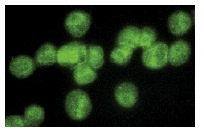
Immunofluorescence staining of methanol-fixed KNRK cells showing nuclear localization.Application
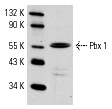
Western blot analysis of Pbx 1 expression in KNRK nuclear extract.| Product Name | Pbx 1 Antibody (P-20) |
|---|---|
| Antibody Type | Primary Antibodies |
| Antigen Alias | epitope mapping at the N-terminus of Pbx 1 of human origin |
| Modification Notes | Pbx 1, 2, 3 and 4 are members of the TALE (three amino acid loop extension) family of homeodomain-containing proteins. Human pre-B cell acute leukemias are frequently associated with a t(1;19)(q23;p13.3) chromosomal rearrangement, which creates a chimeric gene encoding a fusion between the E2A and Pbx 1 gene products. Pbx 2 and Pbx 3 share 92% and 94% respective identities with Pbx 1 over a 266 amino acid region flanking their homeobox domains, while all three proteins are quite divergent at their amino- and carboxy-termini. Two forms of Pbx 1 and Pbx 3 each differ primarily in their carboxy-termini and result from alternative mRNA splicing. Unlike other homeotic selector genes which are expressed transiently during development and differentiation, Pbx gene transcripts are ubiquitously expressed in both fetal and adult tissues and cell lines. Additionally, Pbx 2 and Pbx 3 transcripts are detected in lymphoid cells, which do not express Pbx 1. Pbx 4 expression is confined to the testis, especially to spermatocytes in the pachytene stage of the first meiotic prophase. |
| Clonality | Polyclonal |
|---|---|
| Isotype | IgG |
| Host Species | Rabbit |
| Tested Applications | WBIPIFELISAGSChIP |
| recommended for detection of Pbx 1 of mouse, rat and human origin by WB, IP, IF and ELISA also reactive with additional species, including canine, bovine and porcine: |
|
| Species Reactivity | HumanMouseRat |
| Concentration | 1mg/ml |
| Purification | Affinity purified |
| Alternative Names | epitope mapping at the N-terminus of Pbx 1 of human origin |
|---|---|
| Tissue Specificity | epitope mapping at the N-terminus of Pbx 1 of human origin |
| Entrez Gene | 5087 |
|---|
Application
Immunofluorescence staining of methanol-fixed KNRK cells showing nuclear localization.
Application
Western blot analysis of Pbx 1 expression in KNRK nuclear extract.| Application Notes | recommended for detection of Pbx 1 of mouse, rat and human origin by WB, IP, IF and ELISA also reactive with additional species, including canine, bovine and porcine: |
|---|
| Form | Liquid |
|---|---|
| Storage Instructions | For short-term storage, store at 4° C. For long-term storage, aliquot and store at -20ºC or below. Avoid multiple freeze-thaw cycles. |
| Storage Buffer | phosphate buffered saline , pH 7.4, 150mM NaCl, 0.02% sodium azide and 50% glycerol. |


