Application
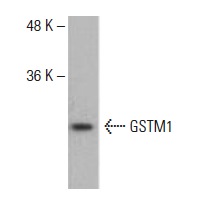
Western blot analysis of GSTM1 expression in Jurkat whole cell lysate.Application
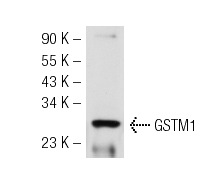
Western blot analysis of GSTM1 expression in mouse liver tissue extract.| Product Name | GSTM1 Antibody (U-21) |
|---|---|
| Antibody Type | Primary Antibodies |
| Antigen Alias | recommended for detection of GSTM1 of mouse, rat and human origin by WB, IP and ELISA; also reactive with additional species, including canine |
| Modification Notes | Members of the Glutathione S-transferase (GST) family of proteins function in the detoxification of xenobiotics to protect cells against toxicant-induced damage. GSTs are differentially expressed in lung, liver and kidney tissue and, notably, three isoforms (GSTA1-1, GSTA1-4 and GSTM1) localize to the mitochondria in addition to the cytoplasm. In normal and transformed cells, the oncoprotein Myb transcriptionally upregulates GSTM1. This isoform shows high specific activity for Aflatoxin B1 epoxide conjugation, suggesting an important role for this interaction in the defense against both chemical and oxidative stress. |
| Clonality | Polyclonal |
|---|---|
| Isotype | IgG |
| Host Species | Rabbit |
| Tested Applications | WBIPELISA |
| See 1 citations for GSTM1Antibody (U-21): |
|
| Species Reactivity | HumanMouseRat |
| Concentration | 1mg/ml |
| Purification | Affinity purified |
| Alternative Names | recommended for detection of GSTM1 of mouse rat and human origin by WB IP and ELISA also reactive with additional species including canine |
|---|---|
| Tissue Specificity | recommended for detection of GSTM1 of mouse, rat and human origin by WB, IP and ELISA; also reactive with additional species, including canine |
| Entrez Gene | 2944 |
|---|
Application
Western blot analysis of GSTM1 expression in Jurkat whole cell lysate.
Application
Western blot analysis of GSTM1 expression in mouse liver tissue extract.| Application Notes | See 1 citations for GSTM1Antibody (U-21): |
|---|
| Form | Liquid |
|---|---|
| Storage Instructions | For short-term storage, store at 4° C. For long-term storage, aliquot and store at -20ºC or below. Avoid multiple freeze-thaw cycles. |
| Storage Buffer | phosphate buffered saline , pH 7.4, 150mM NaCl, 0.02% sodium azide and 50% glycerol. |


