Application
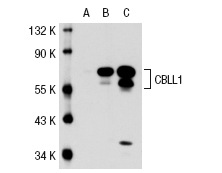
Western blot analysis of CBLL1 expression in non-transfected 293T: (A), human CBLL1 transfected 293T: (B) and HeLa (C) whole cell lysates.| Product Name | CBLL1 Antibody (M-25) |
|---|---|
| Antibody Type | Primary Antibodies |
| Antigen Alias | raised against CBLL1 of human origin |
| Modification Notes | CBLL1 (Casitas B-lineage lymphoma-transforming sequence-like protein 1), also known as HAKAI (meaning ‘destruction’ in Japanese), or RNF188 (RING finger protein 188), is a 491 amino acid protein that contains one C2H2-type zinc finger and one RING-type zinc finger. CBLL1 is believed to function as an E3 ubiquitin-protein ligase that accepts a ubiquitin residue from an E2 ubiquitin-conjugating enzyme and immediately transfers that residue to a protein that is targeted for degradation. More specifically, upon activation of c-Src, CBLL1 interacts with and ubiquitinates tyrosine-phosphorylated E-cadherin, thereby targeting the E-cadherin complex for endocytosis and disrupting epithelial cell-cell contacts. Via its role as an E-cadherin regulator, CBLL1 participates in cell adhesion and may also be involved in the regulation of epithelial-mesenchymal transitions. |
| Clonality | Polyclonal |
|---|---|
| Isotype | IgG |
| Host Species | Rabbit |
| Tested Applications | WBIPELISA |
| recommended for detection of CBLL1 of mouse, rat, human and canine origin by WB, IP and ELISA: |
|
| Species Reactivity | HumanMouseRat |
| Concentration | 1mg/ml |
| Purification | Affinity purified |
| Alternative Names | raised against CBLL1 of human origin |
|---|---|
| Tissue Specificity | raised against CBLL1 of human origin |
| Entrez Gene | 79872 |
|---|
Application
Western blot analysis of CBLL1 expression in non-transfected 293T: (A), human CBLL1 transfected 293T: (B) and HeLa (C) whole cell lysates.| Application Notes | recommended for detection of CBLL1 of mouse, rat, human and canine origin by WB, IP and ELISA: |
|---|
| Form | Liquid |
|---|---|
| Storage Instructions | For short-term storage, store at 4° C. For long-term storage, aliquot and store at -20ºC or below. Avoid multiple freeze-thaw cycles. |
| Storage Buffer | phosphate buffered saline , pH 7.4, 150mM NaCl, 0.02% sodium azide and 50% glycerol. |


