Application
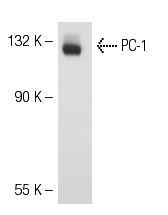
Western blot analysis of PC-1 expression in Hep G2 whole cell lysate.| Product Name | PC-1 Antibody (H-120) |
|---|---|
| Antibody Type | Primary Antibodies |
| Antigen Alias | epitope corresponding to amino acids 11-120 mapping near the N-terminus of PC-1 of human origin |
| Modification Notes | PC-1, also known as ectonucleotide pyrophosphatase/phosphodiesterase 1 (ENPP1) or membrane component, chromosome 6, surface marker-1 (M6S1), is the human homolog of Ly-41 in the mouse. PC-1 is a homodimer with restricted tissue distribution, being first characterized in plasma cells. In addition to its expression on plasma cells, PC-1 is expressed on hepatocytes, renal tubules, salivary duct epithelium, epididymis, capillary endothelium in the brain and chondrocytes. Most patients with non-insulin-dependent diabetes mellitus (NIDDM) are resistant to both endogenous and exogenous insulin. Insulin resistance precedes the onset of this disease, suggesting that it may be an initial abnormality. It has been suggested that PC-1 may have a role in the insulin resistance of NIDDM by direct interaction with the receptor a subunit. The gene which encodes PC-1 maps to human chromosome 6q22-q23, which is a common site for deletions in human lymphoid neoplasia. |
| Clonality | Polyclonal |
|---|---|
| Isotype | IgG |
| Host Species | Rabbit |
| Tested Applications | WBIPIFELISA |
| recommended for detection of PC-1 of mouse, rat and human origin by WB, IP, IF and ELISA also reactive with additional species, including canine: |
|
| Species Reactivity | HumanMouseRat |
| Concentration | 1mg/ml |
| Purification | Affinity purified |
| Alternative Names | epitope corresponding to amino acids 11-120 mapping near the N-terminus of PC-1 of human origin |
|---|---|
| Tissue Specificity | epitope corresponding to amino acids 11-120 mapping near the N-terminus of PC-1 of human origin |
| Entrez Gene | 5167 |
|---|
Application
Western blot analysis of PC-1 expression in Hep G2 whole cell lysate.| Application Notes | recommended for detection of PC-1 of mouse, rat and human origin by WB, IP, IF and ELISA also reactive with additional species, including canine: |
|---|
| Form | Liquid |
|---|---|
| Storage Instructions | For short-term storage, store at 4° C. For long-term storage, aliquot and store at -20ºC or below. Avoid multiple freeze-thaw cycles. |
| Storage Buffer | phosphate buffered saline , pH 7.4, 150mM NaCl, 0.02% sodium azide and 50% glycerol. |


