Application
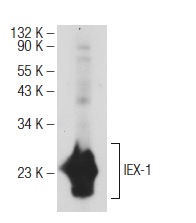
Western blot analysis of IEX-1 expression in C32 whole cell lysate.| Product Name | IEX-1 Antibody (FL-156) |
|---|---|
| Antibody Type | Primary Antibodies |
| Antigen Alias | epitope corresponding to amino acids 1-156 representing full length IEX-1 of human origin |
| Modification Notes | Tumors are frequently observed as resistant to apoptotic induction by FAS, tumor necrosis factor a (TNFa) or irradiation. This anti-death activity may be attributed to immediate early-response genes that are regulated at the transcriptional level, including the protein IEX-1. IEX-1 was originally characterized as a gene induced by ultraviolet radiation and TNFa, which protected human squamous carcinoma cells from apoptosis. Subsequent transfection studies have also shown that expression of IEX-1 in human keratinocytes and mouse fibroblasts results in more rapid proliferation of the cells as compared with controls. The promoter region of IEX-1 contains binding motifs for both NFkB and p53, suggesting that these proteins may regulate its expression. IEX-1 is expressed as both a longer form (IEX-1L) and a splice variant, designated IEX-1S to indicate the shorter form. It is localized to the nucleus and perinuclear region. |
| Clonality | Polyclonal |
|---|---|
| Isotype | IgG |
| Host Species | Rabbit |
| Tested Applications | WBIPIFELISA |
| recommended for detection of IEX-1 of mouse, rat and human origin by WB, IP, IF and ELISA also reactive with additional species, including porcine: |
|
| Species Reactivity | HumanMouseRat |
| Concentration | 1mg/ml |
| Purification | Affinity purified |
| Alternative Names | epitope corresponding to amino acids 1-156 representing full length IEX-1 of human origin |
|---|---|
| Tissue Specificity | epitope corresponding to amino acids 1-156 representing full length IEX-1 of human origin |
| Entrez Gene | 8870 |
|---|
Application
Western blot analysis of IEX-1 expression in C32 whole cell lysate.| Application Notes | recommended for detection of IEX-1 of mouse, rat and human origin by WB, IP, IF and ELISA also reactive with additional species, including porcine: |
|---|
| Form | Liquid |
|---|---|
| Storage Instructions | For short-term storage, store at 4° C. For long-term storage, aliquot and store at -20ºC or below. Avoid multiple freeze-thaw cycles. |
| Storage Buffer | phosphate buffered saline , pH 7.4, 150mM NaCl, 0.02% sodium azide and 50% glycerol. |


