Application
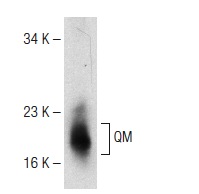
Western blot analysis of QM expression in mouse testis tissue extract.Application
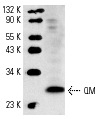
Western blot analysis of QM expression in HeLa whole cell lysate.| Product Name | QM Antibody (N-17) |
|---|---|
| Antibody Type | Primary Antibodies |
| Antigen Alias | epitope mapping at the N-terminus of QM of human origin |
| Modification Notes | The c-Jun protein is a major component of the transcription factor AP-1 (1,2), originally shown to mediate phorbol ester tumor promoter (TPA)-induced expression of responsive genes through the TPA-response element (TRE) (1,2). The Jun proteins form homo- and heterodimers which bind the TRE, while Fos proteins are active only as heterodimers with any of the Jun proteins (3,4). Fos/Jun heterodimers have a much higher affinity for the TRE than Jun homodimers. A distant member of the MAP kinase family, designated c-Jun NH2-terminal kinase (JNK1) functions to regulate c-Jun by phosphorylation at the amino terminal serine regulatory sites, Ser-63 and Ser-73 (5,6). QM has been described as a transcription factor that can function to bind DNA directly or alternatively can interact with c-Jun to inhibit transactivation of AP-1 promoter driven reporter vectors by Jun-Jun homodimers. QM is highly conserved throughout eukaryotic evolution and is apparently a member of a multi-gene family (7). |
| Clonality | Polyclonal |
|---|---|
| Isotype | IgG |
| Host Species | Rabbit |
| Tested Applications | WBIPIFELISAGSChIP |
| recommended for detection of QM of mouse, rat and human origin by WB, IP, IF and ELISA also reactive with additional species, including equine, canine, bovine and porcine: |
|
| Species Reactivity | HumanMouseRat |
| Concentration | 1mg/ml |
| Purification | Affinity purified |
| Alternative Names | epitope mapping at the N-terminus of QM of human origin |
|---|---|
| Tissue Specificity | epitope mapping at the N-terminus of QM of human origin |
| Entrez Gene | 140801 |
|---|
Application
Western blot analysis of QM expression in mouse testis tissue extract.
Application
Western blot analysis of QM expression in HeLa whole cell lysate.| Application Notes | recommended for detection of QM of mouse, rat and human origin by WB, IP, IF and ELISA also reactive with additional species, including equine, canine, bovine and porcine: |
|---|
| Form | Liquid |
|---|---|
| Storage Instructions | For short-term storage, store at 4° C. For long-term storage, aliquot and store at -20ºC or below. Avoid multiple freeze-thaw cycles. |
| Storage Buffer | phosphate buffered saline , pH 7.4, 150mM NaCl, 0.02% sodium azide and 50% glycerol. |


