Application
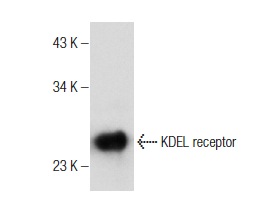
Western blot analysis of KDEL receptor expression in mouse small intestine tissue extract.Application
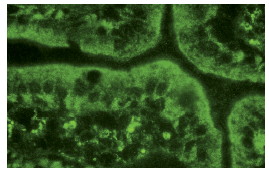
Immunofluorescence staining of normal mouse intestine frozen section showing cytoplasmic staining.| Product Name | KDEL receptor Antibody (FL-212) |
|---|---|
| Antibody Type | Primary Antibodies |
| Antigen Alias | epitope corresponding to amino acids 81-120 mapping within an internal region of KDEL receptor 1 of human origin |
| Modification Notes | Soluble proteins in the endoplasmic reticulum (ER) contain a specific carboxy terminal sequence KDEL (Lys-Asp-Glu-Leu), and include the coat proteins required for vesicle budding from the ER, proteins that form retrograde vesicles on post-ER compartments, and integral membrane proteins that target vesicles to their correct destination (1–4). The retention of these soluble proteins in the ER depends on the interaction of the KDEL sequence with the corresponding KDEL receptor, also designated ERD2, in the Golgi apparatus (1–4). When KDEL proteins reach the Golgi complex, they are recognized by the KDEL receptor and transported retrograde in COPI-coated vesicles back to the ER (1–4). The small GTPase ADP-ribosylation factor 1 (ARF1), a regulator of vesicle transport, interacts with the KDEL receptor (5–7). Subsequently, this interaction allows the KDEL receptor to recruit a GTPase-activating protein (GAP) from the cytosol to membranes, which inactivates ARF1 (5–7). |
| Clonality | Polyclonal |
|---|---|
| Isotype | IgG |
| Host Species | Rabbit |
| Tested Applications | WBIPIFELISA |
| recommended for detection of KDEL receptors 1 and 2 of mouse, rat and human origin by WB, IP, IF and ELISA also reactive with additional species, including equine, canine, bovine, porcine and avian: |
|
| Species Reactivity | HumanMouseRat |
| Concentration | 1mg/ml |
| Purification | Affinity purified |
| Alternative Names | epitope corresponding to amino acids 81-120 mapping within an internal region of KDEL receptor 1 of human origin |
|---|---|
| Tissue Specificity | epitope corresponding to amino acids 81-120 mapping within an internal region of KDEL receptor 1 of human origin |
| Entrez Gene | 10945 |
|---|
Application
Western blot analysis of KDEL receptor expression in mouse small intestine tissue extract.
Application
Immunofluorescence staining of normal mouse intestine frozen section showing cytoplasmic staining.| Application Notes | recommended for detection of KDEL receptors 1 and 2 of mouse, rat and human origin by WB, IP, IF and ELISA also reactive with additional species, including equine, canine, bovine, porcine and avian: |
|---|
| Form | Liquid |
|---|---|
| Storage Instructions | For short-term storage, store at 4° C. For long-term storage, aliquot and store at -20ºC or below. Avoid multiple freeze-thaw cycles. |
| Storage Buffer | phosphate buffered saline , pH 7.4, 150mM NaCl, 0.02% sodium azide and 50% glycerol. |


