Application
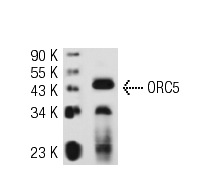
Western blot analysis of ORC5 expression in mouse brain tissue extract.| Product Name | ORC5 Antibody (H-300) |
|---|---|
| Antibody Type | Primary Antibodies |
| Antigen Alias | epitope corresponding to amino acids 136-435 of ORC5 of human origin |
| Modification Notes | The initiation of DNA replication is a multi-step process that depends on the formation of pre-replication complexes, which trigger initiation (1). Among the proteins required for establishing these complexes are the origin recognition complex (ORC) proteins (1). ORC proteins bind specifically to origins of replication where they serve as scaffold for the assembly of additional initiation factors (1). Human ORC subunits 1-6 are expressed in the nucleus of proliferating cells and tissues, such as the testis (2). ORC1 and ORC2 are both expressed at equivalent concentrations throughout the cell cycle; however, only ORC2 remains stably bound to chromatin (3,4). ORC4 and ORC6 are also expressed constantly throughout the cell cycle (5,6). ORC2, ORC3, ORC4 and ORC5 form a core complex upon which ORC6 and ORC1 assemble (7,8). The formation of this core complex suggests that ORC proteins play a crucial role in the G1-S transition in mammalian cells (8). |
| Clonality | Polyclonal |
|---|---|
| Isotype | IgG |
| Host Species | Rabbit |
| Tested Applications | WBIPIFELISAGSChIP |
| recommended for detection of ORC5 of mouse, rat and human origin by WB, IP, IF and ELISA also reactive with additional species, including equine, canine, bovine and avian: |
|
| Species Reactivity | HumanMouseRat |
| Concentration | 1mg/ml |
| Purification | Affinity purified |
| Alternative Names | epitope corresponding to amino acids 136-435 of ORC5 of human origin |
|---|---|
| Tissue Specificity | epitope corresponding to amino acids 136-435 of ORC5 of human origin |
| Entrez Gene | 5001 |
|---|
Application
Western blot analysis of ORC5 expression in mouse brain tissue extract.| Application Notes | recommended for detection of ORC5 of mouse, rat and human origin by WB, IP, IF and ELISA also reactive with additional species, including equine, canine, bovine and avian: |
|---|
| Form | Liquid |
|---|---|
| Storage Instructions | For short-term storage, store at 4° C. For long-term storage, aliquot and store at -20ºC or below. Avoid multiple freeze-thaw cycles. |
| Storage Buffer | phosphate buffered saline , pH 7.4, 150mM NaCl, 0.02% sodium azide and 50% glycerol. |


