Application
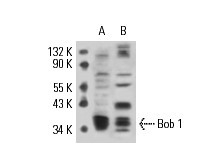
Western blot analysis of Bob 1 expression in PMA-treated MM-142 nuclear extract (A) and Ramos whole cell lysate (B).| Product Name | Bob 1 Antibody (FL-256) |
|---|---|
| Antibody Type | Primary Antibodies |
| Antigen Alias | epitope corresponding to amino acids 1-256 representing full length Bob 1 of human origin |
| Modification Notes | POU domain proteins contain a bipartite DNA-binding domain divided by a flexible linker that enables them to adopt various monomer configurations on DNA. The versatility of POU protein operation is additionally conferred at the dimerization level. The POU dimer from the OCT1 gene formed on the palindromic OCT factor recognition element, or PORE (ATTTGAAATGCAAAT), could recruit the transcriptional coactivator OBF1. Studies of tissue-specific expression of immunoglobulin promoters demonstrate the importance of an octamer, ATTTGCAT, and the proteins that bind to it. This is a regulatory element important for tissue- and cell-specific transcription as well as for transcription of a number of housekeeping genes. Oct-1 encodes one protein, NF-A1, which is found in nuclear extracts from all cell types and thus is not specific to lymphoid cells as is the protein NF-A2, which is encoded by Oct-2. A novel protein designated Bob 1 (B cell Oct binding protein 1), alternatively called OBF-1, specifically interacts with Oct-1 and Oct-2, enhancing their transcriptional efficacy. Bob 1 is expressed at highest levels in spleen and peripheral blood leukocytes and represents an Oct co-factor capable of conferring cell-specific activation of Oct-1 and Oct-2. Although having no intrinsic capacity for DNA binding, Bob 1 associates tightly with the octamer motif in the presence of Oct-1 and/or Oct-2. The gene which encodes Bob 1 maps to human chromosome 11q23.1. |
| Clonality | Polyclonal |
|---|---|
| Isotype | IgG |
| Host Species | Rabbit |
| Tested Applications | WBIPIFELISAGSChIP |
| recommended for detection of Bob 1 of mouse, rat and human origin by WB, IP, IF and ELISA also reactive with additional species, including equine, canine, bovine and porcine: |
|
| Species Reactivity | HumanMouseRat |
| Concentration | 1mg/ml |
| Purification | Affinity purified |
| Alternative Names | epitope corresponding to amino acids 1-256 representing full length Bob 1 of human origin |
|---|---|
| Tissue Specificity | epitope corresponding to amino acids 1-256 representing full length Bob 1 of human origin |
| Entrez Gene | 5450 |
|---|
Application
Western blot analysis of Bob 1 expression in PMA-treated MM-142 nuclear extract (A) and Ramos whole cell lysate (B).| Application Notes | recommended for detection of Bob 1 of mouse, rat and human origin by WB, IP, IF and ELISA also reactive with additional species, including equine, canine, bovine and porcine: |
|---|
| Form | Liquid |
|---|---|
| Storage Instructions | For short-term storage, store at 4° C. For long-term storage, aliquot and store at -20ºC or below. Avoid multiple freeze-thaw cycles. |
| Storage Buffer | phosphate buffered saline , pH 7.4, 150mM NaCl, 0.02% sodium azide and 50% glycerol. |


