Application
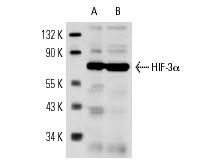
Western blot analysis of HIF-3α expression in mouse liver (A) and rat liver (B) tissue extracts.| Product Name | HIF-3α Antibody (H-170) |
|---|---|
| Antibody Type | Primary Antibodies |
| Antigen Alias | epitope corresponding to amino acids 498-667 mapping at the C-terminus of HIF-3α of human origin |
| Modification Notes | Cell growth and viability is compromised by oxygen deprivation (hypoxia). Hypoxia-inducible factors, including HIF-1a, HIF-1b (also designated Arnt 1), EPAS-1 (also designated HIF-2a) and HIF-3a, induce glycolysis, erythropoiesis and angiogenesis in order to restore oxygen homeostasis. Hypoxia-inducible factors are members of the Per-Arnt-Sim (PAS) domain transcription factor family. In response to hypoxia, HIF-1a is upregulated and forms a heterodimer with Arnt 1 to form the HIF-1 complex. The HIF-1 complex recognizes and binds to the hypoxia responsive element (HRE) of hypoxia-inducible genes, thereby activating transcription. Hypoxia-inducible expression of some genes such as Glut-1, p53, p21 or Bcl-2, is HIF-1a dependent, whereas expression of others, such as p27, GADD 153 or HO-1, is HIF-1a independent. EPAS-1 and HIF-3a have also been shown to form heterodimeric complexes with Arnt 1 in response to hypoxia. |
| Clonality | Polyclonal |
|---|---|
| Isotype | IgG |
| Host Species | Rabbit |
| Tested Applications | WBIPIFELISAGSChIP |
| recommended for detection of HIF-3α of human and, to a lesser extent, mouse and rat origin by WB, IP, IF and ELISA also reactive with additional species, including equine: |
|
| Species Reactivity | HumanMouseRat |
| Concentration | 1mg/ml |
| Purification | Affinity purified |
| Alternative Names | epitope corresponding to amino acids 498-667 mapping at the C-terminus of HIF-3&alpha of human origin |
|---|---|
| Tissue Specificity | epitope corresponding to amino acids 498-667 mapping at the C-terminus of HIF-3α of human origin |
| Entrez Gene | 64344 |
|---|
Application
Western blot analysis of HIF-3α expression in mouse liver (A) and rat liver (B) tissue extracts.| Application Notes | recommended for detection of HIF-3α of human and, to a lesser extent, mouse and rat origin by WB, IP, IF and ELISA also reactive with additional species, including equine: |
|---|
| Form | Liquid |
|---|---|
| Storage Instructions | For short-term storage, store at 4° C. For long-term storage, aliquot and store at -20ºC or below. Avoid multiple freeze-thaw cycles. |
| Storage Buffer | phosphate buffered saline , pH 7.4, 150mM NaCl, 0.02% sodium azide and 50% glycerol. |


