Application
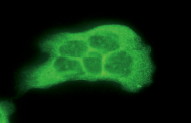
Immunofluorescence staining of methanol-fixed A-431 cells showing cytoskeletal localization.| Product Name | BPAG1 Antibody (H-80) |
|---|---|
| Antibody Type | Primary Antibodies |
| Antigen Alias | epitope corresponding to amino acids 3135-3214 mapping at the C-terminus of BPAG1 of human origin |
| Modification Notes | As basal cells of stratified squamous epithelia begin to migrate in response to wound healing, they lose their cell-substrate adhesion junctions, the hemidesmosomes (1). The hemidesmosome is an adhesion structure of the epidermal-dermal junction in keratinocytes (2). When keratinocytes migrate laterally or upward to differentiate they must control the formation and disintegration of the hemidesmosomes (2). The bullous pemphigoid antigen BPAG1 is a hemidesmosomal protein of the cutaneous basement membrane zone (3,4). The primary sequence deduced from full-length human cDNAs predicts that this molecule consists of a central rod region and flanking globular domains (3,4). A neuronal isoform, BPAG1n3 is the result of differential splicing of BPAG1 (5). BPAG1n3 is distinguished by its initial 32 amino acid residues and by the absence of the amino-terminal half of the actin-binding domain (5). |
| Clonality | Polyclonal |
|---|---|
| Isotype | IgG |
| Host Species | Rabbit |
| Tested Applications | WBIPIFELISA |
| recommended for detection of BPAG1 isofoms 1-5 and 8 of mouse, rat and human origin by WB, IP, IF and ELISA also reactive with additional species, including equine, canine, bovine and porcine: |
|
| Species Reactivity | HumanMouseRat |
| Concentration | 1mg/ml |
| Purification | Affinity purified |
| Alternative Names | epitope corresponding to amino acids 3135-3214 mapping at the C-terminus of BPAG1 of human origin |
|---|---|
| Tissue Specificity | epitope corresponding to amino acids 3135-3214 mapping at the C-terminus of BPAG1 of human origin |
| Entrez Gene | 667 |
|---|
Application
Immunofluorescence staining of methanol-fixed A-431 cells showing cytoskeletal localization.| Application Notes | recommended for detection of BPAG1 isofoms 1-5 and 8 of mouse, rat and human origin by WB, IP, IF and ELISA also reactive with additional species, including equine, canine, bovine and porcine: |
|---|
| Form | Liquid |
|---|---|
| Storage Instructions | For short-term storage, store at 4° C. For long-term storage, aliquot and store at -20ºC or below. Avoid multiple freeze-thaw cycles. |
| Storage Buffer | phosphate buffered saline , pH 7.4, 150mM NaCl, 0.02% sodium azide and 50% glycerol. |


