Application
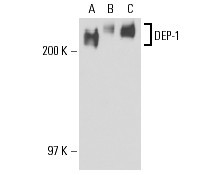
Western blot analysis of DEP-1 expression in human PBL (A), HL-60 (B) and THP-1 (C) whole cell lysates.| Product Name | DEP-1 Antibody (H-300) |
|---|---|
| Antibody Type | Primary Antibodies |
| Antigen Alias | epitope corresponding to amino acids 1-300 of DEP-1 of human origin |
| Modification Notes | Density-enhanced phosphatase-1 (DEP-1), a receptor-like protein tyrosine phosphatase, also known as HPTP-eta/CD148, is involved in signal transduction in leukocytes and in the mechanisms of cellular differentiation (1–2). DEP-1 consists of an extracellular segment containing eight fibronectin type III repeats, a single transmembrane segment and a single intracellular PTP domain (3,4). In lymphoid organs, DEP-1 is widely expressed on B and T cells, granulocytes, macrophages, certain dendritic cells, mature thymocytes (2) and neutrophils (5). In non-lymphoid tissues, it is expressed on fibrocytes, melanocytes and Schwann cells, and many epithelial cell types with glandular and/or endocrine differentiation (2). In Jurkat T cells, DEP-1 inhibits TCR-mediated activation, which results in reduced expression of the early activation of Ag CD69, inhibition of tyrosine phosphorylation of many intracellular proteins, including tyrosine kinase ZAP-70 and impairment of mitogen-activated protein kinase activation (6–7). In spite of its intrinsic enzymatic activity, DEP-1 can induce protein tyrosine phosphorylation in human lymphocytes (8), and serine/threonine and/or tyrosine phosphorylation in tumor cell lines (9). |
| Clonality | Polyclonal |
|---|---|
| Isotype | IgG |
| Host Species | Rabbit |
| Tested Applications | WBIPIFELISA |
| recommended for detection of DEP-1 of human origin by WB, IP, IF and ELISA: |
|
| Species Reactivity | HumanMouseRat |
| Concentration | 1mg/ml |
| Purification | Affinity purified |
| Alternative Names | epitope corresponding to amino acids 1-300 of DEP-1 of human origin |
|---|---|
| Tissue Specificity | epitope corresponding to amino acids 1-300 of DEP-1 of human origin |
| Entrez Gene | 5795 |
|---|
Application
Western blot analysis of DEP-1 expression in human PBL (A), HL-60 (B) and THP-1 (C) whole cell lysates.| Application Notes | recommended for detection of DEP-1 of human origin by WB, IP, IF and ELISA: |
|---|
| Form | Liquid |
|---|---|
| Storage Instructions | For short-term storage, store at 4° C. For long-term storage, aliquot and store at -20ºC or below. Avoid multiple freeze-thaw cycles. |
| Storage Buffer | phosphate buffered saline , pH 7.4, 150mM NaCl, 0.02% sodium azide and 50% glycerol. |


