Application
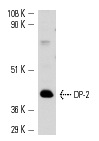
Western blot analysis of DP-2 expression in KNRK nuclear extract.| Product Name | DP-2 Antibody (N-20) |
|---|---|
| Antibody Type | Primary Antibodies |
| Modification Notes | The human retinoblastoma gene product appears to play an important role in the negative regulation of cell proliferation. Functional inactivation of Rb can be mediated either through mutation or as a consequence of interaction with DNA tumor virus-encoded proteins. Of all the Rb associations described to date, the identification of a complex between Rb and the transcription factor E2F most directly implicates Rb in regulation of cell proliferation. E2F was originally identified through its role in transcriptional activation of the adenovirus E2 promoter. Sequences homologous to the E2F binding site have been found upstream of a number of genes that encode proteins with putative functions in the G1 and S phases of the cell cycle. E2F-1 forms heterodimers with a second protein, designated DP-1, forming an “active” E2F transcriptional regulatory complex. Additional members of the E2F family include E2F-2, E2F-3, E2F-4, E2F-5 and DP-2. |
| Clonality | Polyclonal |
|---|---|
| Isotype | IgG |
| Host Species | Rabbit |
| Tested Applications | WBIPIFELISAGSChIP |
| recommended for detection of DP-2 of mouse, rat and human origin by WB, IP, IF and ELISA also reactive with additional species, including equine, canine, bovine, porcine and avian | |
| Species Reactivity | HumanMouseRat |
| Concentration | 1mg/ml |
| Purification | Affinity purified |
| Alternative Names | epitope mapping at the N-terminus of DP-2 of human origin |
|---|---|
| Tissue Specificity | epitope mapping at the N-terminus of DP-2 of human origin |
| Entrez Gene | 7029 |
|---|
Application
Western blot analysis of DP-2 expression in KNRK nuclear extract.| Application Notes | recommended for detection of DP-2 of mouse, rat and human origin by WB, IP, IF and ELISA also reactive with additional species, including equine, canine, bovine, porcine and avian |
|---|
| Form | Liquid |
|---|---|
| Storage Instructions | For short-term storage, store at 4° C. For long-term storage, aliquot and store at -20ºC or below. Avoid multiple freeze-thaw cycles. |
| Storage Buffer | phosphate buffered saline , pH 7.4, 150mM NaCl, 0.02% sodium azide and 50% glycerol. |


