Application
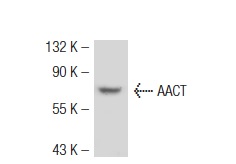
Western blot analysis of AACT expression in T98G whole cell lysate.| Product Name | AACT Antibody (H-50) |
|---|---|
| Antibody Type | Primary Antibodies |
| Antigen Alias | epitope corresponding to amino acids 128-177 mapping to an internal region of AACT of human origin |
| Modification Notes | The serine proteinase inhibitors (serpins) are a superfamily of proteins with a diverse set of functions, including the control of blood coagulation, complement activation, programmed cell death and development. The most abundant serpins in human plasma are a 1-antitrypsin (AAT) and a 1-antichymotrypsin (AACT). AACT (also called A1AC and SERPINA3) is a plasma protease inhibitor synthesized in the liver as a single glycopeptide chain. In human, the normal serum level of AACT is about one-tenth that of AAT, with which it shares nucleic acid and protein sequence homology. Both are major acute phase reactants; their concentrations in plasma increase in response to trauma, surgery and infection. Elevated levels of AACT are widely, but not universally, reported in the cerebrospinal fluid and plasma of AD patients. Prostate-specific antigen (PSA) and its SDS-stable complex with AACT are in widespread use as markers for the diagnosis of prostate cancer. AACT deficiency may also be a possible cause of chronic liver disease. |
| Clonality | Polyclonal |
|---|---|
| Isotype | IgG |
| Host Species | Rabbit |
| Tested Applications | WBIPIFELISA |
| recommended for detection of AACT of human origin by WB, IP, IF and ELISA: |
|
| Species Reactivity | HumanMouseRat |
| Concentration | 1mg/ml |
| Purification | Affinity purified |
| Alternative Names | epitope corresponding to amino acids 128-177 mapping to an internal region of AACT of human origin |
|---|---|
| Tissue Specificity | epitope corresponding to amino acids 128-177 mapping to an internal region of AACT of human origin |
| Entrez Gene | 12 |
|---|
Application
Western blot analysis of AACT expression in T98G whole cell lysate.| Application Notes | recommended for detection of AACT of human origin by WB, IP, IF and ELISA: |
|---|
| Form | Liquid |
|---|---|
| Storage Instructions | For short-term storage, store at 4° C. For long-term storage, aliquot and store at -20ºC or below. Avoid multiple freeze-thaw cycles. |
| Storage Buffer | phosphate buffered saline , pH 7.4, 150mM NaCl, 0.02% sodium azide and 50% glycerol. |


