Application
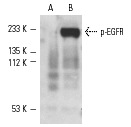
Western blot analysis of EGFR phosphorylation in A-431 (A) and EGF-treated A-431 (B) whole cell lysates.| Product Name | p-Tyr Antibody (PY350) AC |
|---|---|
| Antibody Type | Primary Antibodies |
| Antigen Alias | specific detection of phosphotyrosine containing proteins by WB, IP, IF and ELISA; non cross-reactive with phosphoserine or phosphothreonine |
| Modification | Phosphoralated |
| Modification Notes | The critical involvement of protein tyrosine kinases in signal transduction pathways is well established. These kinases can be divided into two major groups, including the receptor tyrosine kinases and the non-receptor type kinases, of which the Src kinases are the prototypical members. Src kinases are generally associated with the internal portion of the plasma membrane and may function as signal transducers in association with surface receptors that lack an intracellular catalytic domain. The second major group of tyrosine kinases are the receptor tyrosine kinases. More than fifty members of this group of receptors, belonging to fourteen families, have been identified to date. Ligand-induced tyrosine phosphorylation of such receptors induces receptor dimerization and subsequent autophosphorylation of specific individual phosphotyrosine residues located within their cytoplasmic domains, which serve as binding sites that interact with specific cytoplasmic molecules. Monoclonal antibodies to phosphotyrosine are valuable for the characterization and purification of proteins containing phosphotyrosyl residues, and are used extensively for these purposes . |
| Clonality | Polyclonal |
|---|---|
| Isotype | IgG |
| Host Species | Rabbit |
| Tested Applications | WBIPIFELISA |
| blocking peptide, sc-18182 P: |
|
| Species Reactivity | HumanMouseRat |
| Concentration | 1mg/ml |
| Purification | Affinity purified |
| Alternative Names | specific detection of phosphotyrosine containing proteins by WB IP IF and ELISA non cross-reactive with phosphoserine or phosphothreonine |
|---|---|
| Tissue Specificity | specific detection of phosphotyrosine containing proteins by WB, IP, IF and ELISA; non cross-reactive with phosphoserine or phosphothreonine |
Application
Western blot analysis of EGFR phosphorylation in A-431 (A) and EGF-treated A-431 (B) whole cell lysates.| Application Notes | blocking peptide, sc-18182 P: |
|---|
| Form | Liquid |
|---|---|
| Storage Instructions | For short-term storage, store at 4° C. For long-term storage, aliquot and store at -20ºC or below. Avoid multiple freeze-thaw cycles. |
| Storage Buffer | phosphate buffered saline , pH 7.4, 150mM NaCl, 0.02% sodium azide and 50% glycerol. |


