Application
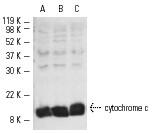
Western blot analysis of cytochrome c expression in HL-60 (A), K-562 (B) andPC-3 (C) whole cell lysates.| Product Name | cytochrome c Antibody (H-104) AC |
|---|---|
| Antibody Type | Primary Antibodies |
| Modification Notes | Cytochrome c is a well characterized mobile electron transport protein that is essential to energy conversion in all aerobic organisms. In mammalian cells, this highly conserved protein is normally localized to the mitochondrial intermembrane space. More recent studies have identifed cytosolic cytochrome c as a factor necessary for activation of apoptosis. During apoptosis, cytochrome c is translocated from the mitochondrial membrane to the cytosol, where it is required for activation of caspase-3 (CPP32). Overexpression of Bcl-2 has been shown to prevent the translocation of cytochrome c, thereby blocking the apoptotic process. Overexpression of Bax has been shown to induce the release of cytochrome c and to induce cell death. The release of cytochrome c from the mitochondria is thought to trigger an apoptotic cascade, whereby Apaf-1 binds to Apaf-3 (caspase-9) in a cytochrome c-dependent manner, leading to caspase-9 cleavage of caspase-3. |
| Clonality | Polyclonal |
|---|---|
| Isotype | IgG |
| Host Species | Rabbit |
| Tested Applications | WBIPIFELISA |
| recommended for detection of cytochrome c of mouse, rat, human, equine and Drosophila origin by WB, IP, IF and ELISA also reactive with additional species, including equine, canine, bovine, porcine and avian | |
| Species Reactivity | HumanMouseRat |
| Concentration | 1mg/ml |
| Purification | Affinity purified |
| Alternative Names | epitope corresponding to amino acids 1-104 representing full length cytochrome c of equine origin |
|---|---|
| Tissue Specificity | epitope corresponding to amino acids 1-104 representing full length cytochrome c of equine origin |
| Entrez Gene | 54205 |
|---|
Application
Western blot analysis of cytochrome c expression in HL-60 (A), K-562 (B) andPC-3 (C) whole cell lysates.| Application Notes | recommended for detection of cytochrome c of mouse, rat, human, equine and Drosophila origin by WB, IP, IF and ELISA also reactive with additional species, including equine, canine, bovine, porcine and avian |
|---|
| Form | Liquid |
|---|---|
| Storage Instructions | For short-term storage, store at 4° C. For long-term storage, aliquot and store at -20ºC or below. Avoid multiple freeze-thaw cycles. |
| Storage Buffer | phosphate buffered saline , pH 7.4, 150mM NaCl, 0.02% sodium azide and 50% glycerol. |


