Application
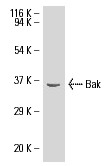
Western blot analysis of Bak expression in Jurkat whole cell lysate.| Product Name | Bak Antibody (H-211) |
|---|---|
| Antibody Type | Primary Antibodies |
| Modification Notes | The Bcl-2 family of proteins is characterized by its ability to modulate cell death (apoptosis) under a broad range of physiologic conditions . Bcl-2 and several related proteins function to inhibit apoptosis, while other members of the Bcl-2 family, such as Bax, accelerate death under various conditions. One member of the Bcl-2 family, designated Bak, functions primarily to enhance apoptotic cell death following appropriate activating signals and, in addition, counteracts the protection from apoptosis provided by Bcl-2. Expression of Bak is widespread in a broad range of cells, including various long-lived, terminally differentiated cell types, suggesting that its cell death-inducing activity is broadly distributed and that the regulation of inhibitors of apoptosis may represent an important determinant of tissue-specific modulation of apoptosis. |
| Clonality | Polyclonal |
|---|---|
| Isotype | IgG |
| Host Species | Rabbit |
| Tested Applications | WBIPIFELISA |
| recommended for detection of Bak of mouse, rat and human origin by WB, IP, IF and ELISA also reactive with additional species, including equine, canine, bovine and porcine | |
| Species Reactivity | HumanMouseRat |
| Concentration | 1mg/ml |
| Purification | Affinity purified |
| Alternative Names | epitope corresponding to amino acids 1-211 representing full length Bak of human origin |
|---|---|
| Tissue Specificity | epitope corresponding to amino acids 1-211 representing full length Bak of human origin |
| Entrez Gene | 578 |
|---|
Application
Western blot analysis of Bak expression in Jurkat whole cell lysate.| Application Notes | recommended for detection of Bak of mouse, rat and human origin by WB, IP, IF and ELISA also reactive with additional species, including equine, canine, bovine and porcine |
|---|
| Form | Liquid |
|---|---|
| Storage Instructions | For short-term storage, store at 4° C. For long-term storage, aliquot and store at -20ºC or below. Avoid multiple freeze-thaw cycles. |
| Storage Buffer | phosphate buffered saline , pH 7.4, 150mM NaCl, 0.02% sodium azide and 50% glycerol. |


