Application
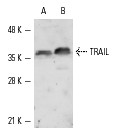
Western blot analysis of TRAIL expression in A549 (A) and AT-3 (B) whole cell lysates.| Product Name | TRAIL Antibody (H-257) |
|---|---|
| Antibody Type | Primary Antibodies |
| Modification Notes | Proteins belonging to the tumor necrosis factor (TNF) superfamily are potent mediators of the inflammation and immune systems. Members of the TNF superfamily include TNF∫, lymphotoxin ∫ (LT∫), CD40L, CD30L, CD27L, Ox40L, 4-1BBL and FAS-L (Apo-1). Most TNF family members are type II transmembrane proteins that are proteolytically processed at their carboxy-terminal extracellular domain to form a soluble homotrimeric molecule. The extracellular domain of an additional TNF family member, designated TNF-related apoptosis-inducing ligand (TRAIL) or Apo-2L, exhibits 14-28% homology with other members of the TNF family. Like soluble FAS-L, soluble TRAIL will induce apoptosis. The morphological and cellular changes caused by the introduction of soluble TRAIL to Jurkat cells are indistinguishable from those caused by the introduction of soluble FAS-L. Unlike FAS-L, whose expression is more or less restricted to activated T cells, significant levels of TRAIL are observed in many tissues and it is constitutively expressed by some cell lines. |
| Clonality | Polyclonal |
|---|---|
| Isotype | IgG |
| Host Species | Rabbit |
| Tested Applications | WBIPIFELISA |
| recommended for detection of TRAIL of mouse, rat and human origin by WB, IP, IF and ELISA | |
| Species Reactivity | HumanMouseRat |
| Concentration | 1mg/ml |
| Purification | Affinity purified |
| Alternative Names | epitope corresponding to amino acids 25-281 mapping at the C-terminus of TRAIL of human origin |
|---|---|
| Tissue Specificity | epitope corresponding to amino acids 25-281 mapping at the C-terminus of TRAIL of human origin |
| Entrez Gene | 8743 |
|---|
Application
Western blot analysis of TRAIL expression in A549 (A) and AT-3 (B) whole cell lysates.| Application Notes | recommended for detection of TRAIL of mouse, rat and human origin by WB, IP, IF and ELISA |
|---|
| Form | Liquid |
|---|---|
| Storage Instructions | For short-term storage, store at 4° C. For long-term storage, aliquot and store at -20ºC or below. Avoid multiple freeze-thaw cycles. |
| Storage Buffer | phosphate buffered saline , pH 7.4, 150mM NaCl, 0.02% sodium azide and 50% glycerol. |


