Application
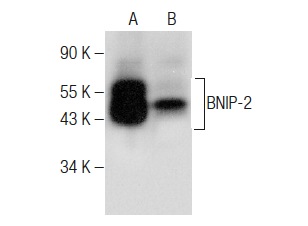
Western blot analysis of BNIP-2 expression in Jurkat (A) and MDA-MB-231 (B) whole cell lysates.| Product Name | BNIP-2 Antibody (H-126) |
|---|---|
| Antibody Type | Primary Antibodies |
| Modification Notes | The adenovirus E1B protein is a viral homolog of the Bcl-2 family of proteins that are involved in regulating cell death. A family of interacting proteins, which are designated Nip or Bnip and include BNIP-1, BNIP-2, BNIP-3 and Nix, associate with both the E1B protein and Bcl-2 proteins to mediate apoptotic signaling. BNIP-1 contains a hydrophobic transmembrane domain, which enables its localization to the nuclear envelope, endoplasmic recticulum and mitochondria. BNIP-2, (previously designated Nip2 and Nip21 in human and mouse respectively), shares homology with the non-catalytic domain of Cdc42 GTPase-activating protein (Cdc42GAP). Through binding to Cdc42GAP, BNIP-2 enhances the GTPase activity of Cdc42GAP, facilitating the hydrolysis of GTP bound to Cdc42 and thereby, mediating the signaling pathways involving receptor kinases, small GTPases and apoptotic proteins. Nix, which is also designated Nip3L or Bnip3L, is highly related to BNIP-3, and both proteins localize to the mitochondria where they associate with Bcl-2 proteins. BNIP-3 preferentially binds to Bcl-xL and induces apoptosis by suppressing the anti-apoptosis activity of Bcl-xL. |
| Clonality | Polyclonal |
|---|---|
| Isotype | IgG |
| Host Species | Rabbit |
| Tested Applications | WBIPIFELISA |
| recommended for detection of BNIP-2 of mouse, rat and human origin by WB, IP, IF and ELISA also reactive with additional species, including equine, canine, bovine and porcine | |
| Species Reactivity | HumanMouseRat |
| Concentration | 1mg/ml |
| Purification | Affinity purified |
| Alternative Names | epitope corresponding to amino acids 132-257 mapping within an internal region of BNIP-2 of human origin |
|---|---|
| Tissue Specificity | epitope corresponding to amino acids 132-257 mapping within an internal region of BNIP-2 of human origin |
| Entrez Gene | 663 |
|---|
Application
Western blot analysis of BNIP-2 expression in Jurkat (A) and MDA-MB-231 (B) whole cell lysates.| Application Notes | recommended for detection of BNIP-2 of mouse, rat and human origin by WB, IP, IF and ELISA also reactive with additional species, including equine, canine, bovine and porcine |
|---|
| Form | Liquid |
|---|---|
| Storage Instructions | For short-term storage, store at 4° C. For long-term storage, aliquot and store at -20ºC or below. Avoid multiple freeze-thaw cycles. |
| Storage Buffer | phosphate buffered saline , pH 7.4, 150mM NaCl, 0.02% sodium azide and 50% glycerol. |


