Application
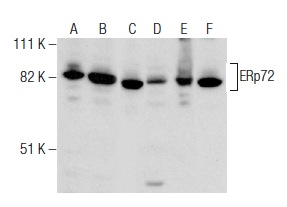
Western blot analysis of ERp72 expression in Jurkat (A), Caki-1 (B), JAR (C), HeLa (D), K-562 (E) and Ramos (F) whole cell lysates.| Product Name | ERp72 Antibody (H-272) |
|---|---|
| Antibody Type | Primary Antibodies |
| Modification Notes | Mammals defend themselves against intracellular pathogens through presentation of cytoplasmically derived short pathogenic peptides to the cell surface of cytotoxic T lymphocytes, which subsequently leads to cytotoxic events with respect to the affected cell. Antigen presentation is mediated by major histocompatibility complex (MHC) class I molecules, which bind and coordinate short pathogenic peptides. The proper folding and assembly of MHC class I molecules in the endoplasmic reticulum (ER) involve a number of components. MHC class I molecules assemble in the ER with chaperones before binding to the transporter associated with antigen processing (TAP) protein. ERp57 is a component of the MHC class I pathway that appears to interact with MHC class I molecules before they associate with TAP. ERp72, also designated protein disulfide-isomerase A4, is involved in the catalysis of protein -S-S- bond rearrangement. ERp57 and ERp72 may act as proteases, protein disulfide isomerases, phospholipases or a combination of these. |
| Clonality | Polyclonal |
|---|---|
| Isotype | IgG |
| Host Species | Rabbit |
| Tested Applications | WBIPIFELISA |
| recommended for detection of ERp72 of mouse, rat and human origin by WB, IP, IF and ELISA also reactive with additional species, including porcine | |
| Species Reactivity | HumanMouseRat |
| Concentration | 1mg/ml |
| Purification | Affinity purified |
| Alternative Names | epitope corresponding to amino acids 257-528 mapping within an internal region of ERp72 of human origin |
|---|---|
| Tissue Specificity | epitope corresponding to amino acids 257-528 mapping within an internal region of ERp72 of human origin |
| Entrez Gene | 9601 |
|---|
Application
Western blot analysis of ERp72 expression in Jurkat (A), Caki-1 (B), JAR (C), HeLa (D), K-562 (E) and Ramos (F) whole cell lysates.| Application Notes | recommended for detection of ERp72 of mouse, rat and human origin by WB, IP, IF and ELISA also reactive with additional species, including porcine |
|---|
| Form | Liquid |
|---|---|
| Storage Instructions | For short-term storage, store at 4° C. For long-term storage, aliquot and store at -20ºC or below. Avoid multiple freeze-thaw cycles. |
| Storage Buffer | phosphate buffered saline , pH 7.4, 150mM NaCl, 0.02% sodium azide and 50% glycerol. |


