Application
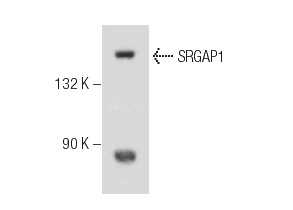
Western blot analysis of SRGAP1 expression in IMR-32 whole cell lysate.| Product Name | SRGAP1 Antibody (H-80) |
|---|---|
| Antibody Type | Primary Antibodies |
| Modification Notes | SRGAPs contain a highly conserved overall primary structure and play an important role in the cell facilitating Slit-robo signaling in cell migration and axon guidance. SRGAP1 (Slit-robo Rho GTPase activating protein 1), also known as ARHGAP13 (Rho GTPase activating protein 13), functions as a GTPase-activating protein for Cdc42 and Rho A. Expressed in kidney, testis, lung and brain, SRGAP1 contains an FCH (Fes/CIP4 homology) domain, a Rho-GAP domain and an SH3 domain. In the presence of Slit, SRGAP1 (via its SH3 domain) binds to the CC3 motif in robo (a protein responsible for mediating the repulsive effect of Slit) with higher affinity and inhibits Cdc42 activity in a robo/SRGAP-dependent manner. More specifically, SRGAP1 increases the intrinsic GTPase activity of Cdc42, thereby converting it to its inactive, GDP-bound form. Inactivation of Cdc42 ultimately leads to a decrease in actin polymerization. |
| Clonality | Polyclonal |
|---|---|
| Isotype | IgG |
| Host Species | Rabbit |
| Tested Applications | WBIPIFELISA |
| recommended for detection of SRGAP1 of mouse, rat and human origin by WB, IP, IF and ELISA also reactive with additional species, including equine, canine, bovine and porcine | |
| Species Reactivity | HumanMouseRat |
| Concentration | 1mg/ml |
| Purification | Affinity purified |
| Alternative Names | epitope corresponding to amino acids 831-910 mapping near the C-terminus of SRGAP1 of human origin |
|---|---|
| Tissue Specificity | epitope corresponding to amino acids 831-910 mapping near the C-terminus of SRGAP1 of human origin |
| Entrez Gene | 57522 |
|---|
Application
Western blot analysis of SRGAP1 expression in IMR-32 whole cell lysate.| Application Notes | recommended for detection of SRGAP1 of mouse, rat and human origin by WB, IP, IF and ELISA also reactive with additional species, including equine, canine, bovine and porcine |
|---|
| Form | Liquid |
|---|---|
| Storage Instructions | For short-term storage, store at 4° C. For long-term storage, aliquot and store at -20ºC or below. Avoid multiple freeze-thaw cycles. |
| Storage Buffer | phosphate buffered saline , pH 7.4, 150mM NaCl, 0.02% sodium azide and 50% glycerol. |


