Application
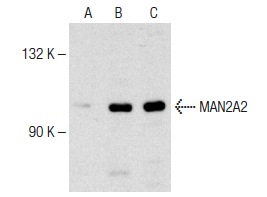
Western blot analysis of MAN2A2 expression in non-transfected 293T: (A), mouse MAN2A2 transfected 293T: (B) and HeLa (C) whole cell lysates.| Product Name | MAN2A2 Antibody (H-74) |
|---|---|
| Antibody Type | Primary Antibodies |
| Modification Notes | The alpha-mannosidases (designated MAN1A1, MAN1A2, MAN2A1 and MAN2A2) comprise a group of soluble proteins that localize to the endoplasmic reticulum, the Golgi apparatus or the cytoplasm. Depending on their cellular location, these proteins are involved in either the processing or the degradation of newly synthesized N-glycans. MAN2A2 (mannosidase alpha class 2A member 2), also known as MANA2X, is a 1,150 amino acid single-pass type II membrane protein that localizes to the Golgi apparatus and exists as three alternatively spliced isoforms. As a disulfide-linked homodimer, MAN2A2 catalyzes the first committed step in the biosynthesis of complex N-glycans by controlling the conversion of high mannose to complex N-glycans. The gene that encodes MAN2A2 consists of approximately 18,396 bases and maps to human chromosome 15q26.1. |
| Clonality | Polyclonal |
|---|---|
| Isotype | IgG |
| Host Species | Rabbit |
| Tested Applications | WBIPIFELISA |
| recommended for detection of MAN2A2 of mouse, rat and human origin by WB, IP, IF and ELISA non cross-reactive with other MAN family members also reactive with additional species, including equine, canine, bovine and porcine | |
| Species Reactivity | HumanMouseRat |
| Concentration | 1mg/ml |
| Purification | Affinity purified |
| Alternative Names | epitope corresponding to amino acids 68-141 mapping near the N-terminus of MAN2A2 of human origin |
|---|---|
| Tissue Specificity | epitope corresponding to amino acids 68-141 mapping near the N-terminus of MAN2A2 of human origin |
| Entrez Gene | 4122 |
|---|
Application
Western blot analysis of MAN2A2 expression in non-transfected 293T: (A), mouse MAN2A2 transfected 293T: (B) and HeLa (C) whole cell lysates.| Application Notes | recommended for detection of MAN2A2 of mouse, rat and human origin by WB, IP, IF and ELISA non cross-reactive with other MAN family members also reactive with additional species, including equine, canine, bovine and porcine |
|---|
| Form | Liquid |
|---|---|
| Storage Instructions | For short-term storage, store at 4° C. For long-term storage, aliquot and store at -20ºC or below. Avoid multiple freeze-thaw cycles. |
| Storage Buffer | phosphate buffered saline , pH 7.4, 150mM NaCl, 0.02% sodium azide and 50% glycerol. |


