Application
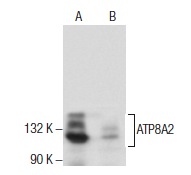
Western blot analysis of ATP8A2 expression in K-562 (A) and T98G (B) whole cell lysates.| Product Name | ATP8A2 Antibody (H-45) |
|---|---|
| Antibody Type | Primary Antibodies |
| Modification Notes | The family of P-type adenosine triphosphates (ATPases), which are phosphorylated in their intermediate state, are involved in the active transport of charged substrates across biological membranes. Members of this family are ubiquitous integral membrane proteins and can be divided into 5 major groups consisting of several subfamilies each. The P-type ATPase Type IV family members are characterized as phospholipid pumps and are then divided into 6 classes determined by sequence similarity. ATP8A2 (ATPase class I type 8A member) is a 1,148 amino acid protein that is strongly expressed in brain, testis and heart. ATP8A2 is a multi-pass transmembrane protein that uses ATP to maintain ion gradients across the cell membrane and may possess some aminophospholipid translocase activity. There are two named isoforms of ATP8A2 which are a result of alternative splicing events. |
| Clonality | Polyclonal |
|---|---|
| Isotype | IgG |
| Host Species | Rabbit |
| Tested Applications | WBIPIFELISA |
| recommended for detection of ATP8A2 of mouse, rat and human origin by WB, IP, IF and ELISA also reactive with additional species, including equine, canine and bovine | |
| Species Reactivity | HumanMouseRat |
| Concentration | 1mg/ml |
| Purification | Affinity purified |
| Alternative Names | epitope corresponding to amino acids 714-758 mapping within an internal region of ATP8A2 of human origin |
|---|---|
| Tissue Specificity | epitope corresponding to amino acids 714-758 mapping within an internal region of ATP8A2 of human origin |
| Entrez Gene | 51761 |
|---|
Application
Western blot analysis of ATP8A2 expression in K-562 (A) and T98G (B) whole cell lysates.| Application Notes | recommended for detection of ATP8A2 of mouse, rat and human origin by WB, IP, IF and ELISA also reactive with additional species, including equine, canine and bovine |
|---|
| Form | Liquid |
|---|---|
| Storage Instructions | For short-term storage, store at 4° C. For long-term storage, aliquot and store at -20ºC or below. Avoid multiple freeze-thaw cycles. |
| Storage Buffer | phosphate buffered saline , pH 7.4, 150mM NaCl, 0.02% sodium azide and 50% glycerol. |


