Application
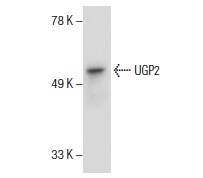
Western blot analysis of UGP2 expression in mouse liver tissue extract.| Product Name | UGP2 Antibody (H-300) |
|---|---|
| Antibody Type | Primary Antibodies |
| Modification Notes | UGP2 (UDP-glucose pyrophosphorylase 2), also known as UDPG, UGPP2, UDPGP2 or pHC379, is an evolutionarily conserved protein belonging to the UDPGP type 1 family of proteins. Localizing to the cytoplasm, UGP2 forms homooligomers and is believed to function as a glucosyl donor in cellular metabolic pathways. More specifically, UGP2 catalyzes the transfer of a glucose moiety from glucose-1-phosphate to UTP, producing a diphosphate and UDP-glucose. UDP-glucose is an essential precursor for the synthesis of polysaccharides; in liver and muscle, UDP-glucose is a precursor of glycogen, in liver UDP-glucose is also a precursor of UDP-glucuronate, and in lactating mammary gland UDP-glucose is converted to UDP-galactose and then to lactose. |
| Clonality | Polyclonal |
|---|---|
| Isotype | IgG |
| Host Species | Rabbit |
| Tested Applications | WBIPIFELISA |
| recommended for detection of UGP2 of mouse, rat and human origin by WB, IP, IF and ELISA also reactive with additional species, including equine, bovine, porcine and avian | |
| Species Reactivity | HumanMouseRat |
| Concentration | 1mg/ml |
| Purification | Affinity purified |
| Alternative Names | epitope corresponding to amino acids 1-300 mapping at the N-terminus of UGP2 of human origin |
|---|---|
| Tissue Specificity | epitope corresponding to amino acids 1-300 mapping at the N-terminus of UGP2 of human origin |
| Entrez Gene | 7360 |
|---|
Application
Western blot analysis of UGP2 expression in mouse liver tissue extract.| Application Notes | recommended for detection of UGP2 of mouse, rat and human origin by WB, IP, IF and ELISA also reactive with additional species, including equine, bovine, porcine and avian |
|---|
| Form | Liquid |
|---|---|
| Storage Instructions | For short-term storage, store at 4° C. For long-term storage, aliquot and store at -20ºC or below. Avoid multiple freeze-thaw cycles. |
| Storage Buffer | phosphate buffered saline , pH 7.4, 150mM NaCl, 0.02% sodium azide and 50% glycerol. |


