Application
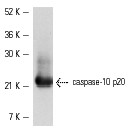
Western blot analysis of human recombinant caspase-10 p20.| Product Name | caspase-10 p20 Antibody (H-131) |
|---|---|
| Antibody Type | Primary Antibodies |
| Modification Notes | A unique family of cysteine proteases has been described that differs in sequence, structure and substrate specificity from any previously described protease family. This family, Ced-3/caspase-1, is comprised of caspase-1, caspase-2, caspase-3, caspase-4, caspase-6, caspase-7 (also designated Mch3, ICE-LAP3 or CMH-1), caspase-9 and caspase-10. Ced-3/caspase-1 family members function as key components of the apoptotic machinery and act to destroy specific target proteins which are critical to cellular longevity. Poly (ADP-ribose) polymerase plays an integral role in surveying for DNA mutations and double strand breaks. Caspase-3, caspase-7 and caspase-9, but not caspase-1, cleave the nuclear protein PARP into an apoptotic fragment. Caspase-6, but not caspase-3, cleaves the nuclear lamins which are critical to maintaining the integrity of the nuclear envelope and cellular morphology. caspase-10 activates caspase-3 and caspase-7 in response to apoptotic stimuli. |
| Clonality | Polyclonal |
|---|---|
| Isotype | IgG |
| Host Species | Rabbit |
| Tested Applications | WBIPIFELISA |
| recommended for detection of the p20 subunit and precursor of caspase-10 of human origin by WB, IP, IF and ELISA | |
| Species Reactivity | HumanMouseRat |
| Concentration | 1mg/ml |
| Purification | Affinity purified |
| Alternative Names | epitope corresponding to amino acids 220-350 mapping within an internal region of caspase-10 of human origin |
|---|---|
| Tissue Specificity | epitope corresponding to amino acids 220-350 mapping within an internal region of caspase-10 of human origin |
| Entrez Gene | 843 |
|---|
Application
Western blot analysis of human recombinant caspase-10 p20.| Application Notes | recommended for detection of the p20 subunit and precursor of caspase-10 of human origin by WB, IP, IF and ELISA |
|---|
| Form | Liquid |
|---|---|
| Storage Instructions | For short-term storage, store at 4° C. For long-term storage, aliquot and store at -20ºC or below. Avoid multiple freeze-thaw cycles. |
| Storage Buffer | phosphate buffered saline , pH 7.4, 150mM NaCl, 0.02% sodium azide and 50% glycerol. |


