Application
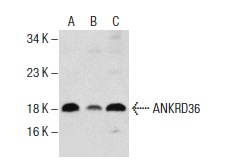
Western blot analysis of ANKRD36 expression in MIA PaCa-2 (A), PC-3 (B) and LNCaP (C) whole cell lysates.Application
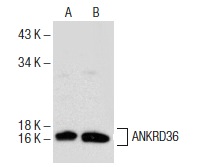
Western blot analysis of ANKRD36 expression in Jurkat (A) and PC-3 (B) whole cell lysates.| Product Name | ANKRD36 Antibody (N-12) |
|---|---|
| Antibody Type | Primary Antibodies |
| Modification Notes | Ankyrins are membrane adaptor molecules that play important roles in coupling integral membrane proteins to the spectrin-based cytoskeleton network. Mutations of ankyrin genes lead to severe genetic diseases, such as fatal cardiac arrhythmias and hereditary spherocytosis. ANKRD36 (ankyrin repeat domain 36), also known as ANKRD36A, is a 1,941 amino acid protein that contains six ANK repeats and belongs to the ANKRD36 family. Existing as four alternatively spliced isoforms, ANKRD36 is encoded by a gene that maps to human chromosome 2q11.2. Translocation of exon 2 at chromosome 2q11.2, which includes ANKRD36, and intron 1 at chromosome 11p15.1 may be associated with T-cell acute lymphoblastic leukemia. As the second largest human chromosome, chromosome 2 makes up approximately 8% of the human genome and contains 237 million bases encoding over 1,400 genes. Chromosome 2 contains a probable vestigial second centromere, as well as vestigial telomeres, which gives credence to the hypothesis that human chromosome 2 formed as a result of an ancient fusion of two ancestral chromosomes, which are still present in modern day apes. |
| Clonality | Polyclonal |
|---|---|
| Isotype | IgG |
| Host Species | Rabbit |
| Tested Applications | WBIPIFELISA |
| recommended for detection of ANKRD36 of human origin by WB, IP, IF and ELISA non cross-reactive with other ANKRD family members | |
| Species Reactivity | HumanMouseRat |
| Concentration | 1mg/ml |
| Purification | Affinity purified |
| Alternative Names | epitope mapping near the N-terminus of ANKRD36 of human origin |
|---|---|
| Tissue Specificity | epitope mapping near the N-terminus of ANKRD36 of human origin |
| Entrez Gene | 375248 |
|---|
Application
Western blot analysis of ANKRD36 expression in MIA PaCa-2 (A), PC-3 (B) and LNCaP (C) whole cell lysates.
Application
Western blot analysis of ANKRD36 expression in Jurkat (A) and PC-3 (B) whole cell lysates.| Application Notes | recommended for detection of ANKRD36 of human origin by WB, IP, IF and ELISA non cross-reactive with other ANKRD family members |
|---|
| Form | Liquid |
|---|---|
| Storage Instructions | For short-term storage, store at 4° C. For long-term storage, aliquot and store at -20ºC or below. Avoid multiple freeze-thaw cycles. |
| Storage Buffer | phosphate buffered saline , pH 7.4, 150mM NaCl, 0.02% sodium azide and 50% glycerol. |


