Application
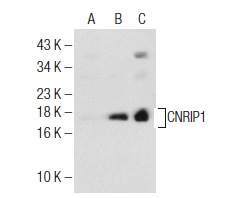
Western blot analysis of CNRIP1 expression in non-transfected 293T: (A), human CNRIP1 transfected 293T: (B) and SH-SY5Y (C) whole cell lysates.| Product Name | CNRIP1 Antibody (K-12) |
|---|---|
| Antibody Type | Primary Antibodies |
| Modification Notes | The cannabinoid receptors (CB1 and CB2) are G protein-coupled receptors that inhibit adenylate cyclase activity in response to psychoactive cannabinoids. CB1 is expressed in brain tissue and, in low levels, in testis. CB2 has been shown to be expressed only by cells of the immune system, specifically by HL-60 cells. The cannabinoid receptors mediate most of the cannabinoid-induced responses in a dose-dependent, stereoselective manner. CNRIP1 (cannabinoid receptor interacting protein 1), also known as CRIP1 (CB1 cannabinoid receptor-interacting protein 1), is a 164 amino acid protein and G-protein coupled receptor that belongs to the CNRIP family. Involved in appetite, synaptic plasticity, neuroprotection and analgesia, CNRIP1 exists as two alternatively spliced isoforms which have been designated CNRIP1 isoforms 1 and 2, or CRIP1a and CRIP1b, respectively. CNRIP1 isoform 1 is known to interact with CB1 but not CB2, thereby suppressing the inhibition of voltage-gated calcium channels. CNRIP1 isoform 2 does not have the same effect. |
| Clonality | Polyclonal |
|---|---|
| Isotype | IgG |
| Host Species | Rabbit |
| Tested Applications | WBIPIFELISA |
| recommended for detection of CNRIP1 of mouse, rat and human origin by WB, IP, IF and ELISA also reactive with additional species, including equine, bovine and porcine | |
| Species Reactivity | HumanMouseRat |
| Concentration | 1mg/ml |
| Purification | Affinity purified |
| Alternative Names | epitope mapping near the C-terminus of CNRIP1 of human origin |
|---|---|
| Tissue Specificity | epitope mapping near the C-terminus of CNRIP1 of human origin |
| Entrez Gene | 25927 |
|---|
Application
Western blot analysis of CNRIP1 expression in non-transfected 293T: (A), human CNRIP1 transfected 293T: (B) and SH-SY5Y (C) whole cell lysates.| Application Notes | recommended for detection of CNRIP1 of mouse, rat and human origin by WB, IP, IF and ELISA also reactive with additional species, including equine, bovine and porcine |
|---|
| Form | Liquid |
|---|---|
| Storage Instructions | For short-term storage, store at 4° C. For long-term storage, aliquot and store at -20ºC or below. Avoid multiple freeze-thaw cycles. |
| Storage Buffer | phosphate buffered saline , pH 7.4, 150mM NaCl, 0.02% sodium azide and 50% glycerol. |


