Application
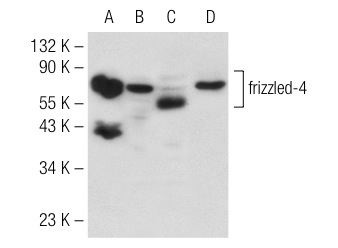
Western blot analysis of frizzled-4 expression in Sol8 (A), ES-2 (B), MIA PaCa-2 (C) and 293T (D) whole cell lysates.| Product Name | frizzled-4 Antibody (H-120) |
|---|---|
| Antibody Type | Primary Antibodies |
| Modification Notes | Frizzled-4 is a 537 amino acid protein encoded by the human gene FZD4. Frizzled-4 acts as a receptor for Wnt proteins. Most frizzled receptors are coupled to the beta-catenin canonical signaling pathway, which leads to the activation of disheveled proteins, inhibition of GSK-3 kinase, nuclear accumulation of beta-catenin and activation of Wnt target genes. A second signaling pathway involving PKC and calcium fluxes has been seen for some family members, but it is not yet clear if it represents a distinct pathway or if it can be integrated in the canonical pathway, as PKC seems to be required for Wnt-mediated inactivation of GSK-3 kinase. Both pathways seem to involve interactions with G-proteins. Frizzled-4 may be involved in transduction and intercellular transmission of polarity information during tissue morphogenesis and/or in differentiated tissues. Frizzled-4 also plays a critical role in retinal angiogenesis. Frizzled-4 is virtually ubiquitously expressed with greatest amounts found in adult heart, skeletal muscle, ovary, and fetal kidney. |
| Clonality | Polyclonal |
|---|---|
| Isotype | IgG |
| Host Species | Rabbit |
| Tested Applications | WBIPIFELISA |
| recommended for detection of frizzled-4 of mouse, rat and human origin by WB, IP, IF and ELISA also reactive with additional species, including equine, canine, bovine, porcine and avian | |
| Species Reactivity | HumanMouseRat |
| Concentration | 1mg/ml |
| Purification | Affinity purified |
| Alternative Names | epitope corresponding to amino acids 105-224 mapping within an internal region of frizzled-4 of human origin |
|---|---|
| Tissue Specificity | epitope corresponding to amino acids 105-224 mapping within an internal region of frizzled-4 of human origin |
| Entrez Gene | 8322 |
|---|
Application
Western blot analysis of frizzled-4 expression in Sol8 (A), ES-2 (B), MIA PaCa-2 (C) and 293T (D) whole cell lysates.| Application Notes | recommended for detection of frizzled-4 of mouse, rat and human origin by WB, IP, IF and ELISA also reactive with additional species, including equine, canine, bovine, porcine and avian |
|---|
| Form | Liquid |
|---|---|
| Storage Instructions | For short-term storage, store at 4° C. For long-term storage, aliquot and store at -20ºC or below. Avoid multiple freeze-thaw cycles. |
| Storage Buffer | phosphate buffered saline , pH 7.4, 150mM NaCl, 0.02% sodium azide and 50% glycerol. |


