Application
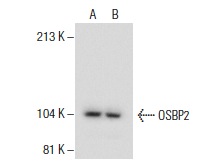
Western blot analysis of OSBP2 expression in BC3H1 (A) and EOC 20 (B) whole cell lysates.| Product Name | OSBP2 Antibody (M-190) |
|---|---|
| Antibody Type | Primary Antibodies |
| Antigen Alias | epitope corresponding to amino acids 1-190 mapping at the N-terminus of OSBP2 of mouse origin |
| Modification Notes | The Oxysterol-binding protein (OSBP) family of proteins consist of OSBP (OSBP1) and OSBP2 (ORP-4), which share a high overall similarity. OSBPs are involved in lipid metabolism and signal transduction, as well as vesicle transport, and can translocate to the periphery of Golgi membranes when they are bound to oxysterols. The OSBP protein transports sterols from lysosomes to the nucleus, where sterols downregulate the genes for HMG synthetase, HMG-CoA reductase and the low density lipoprotein receptor (LDLR). OSBP localizes to the cytosol and is widely expressed, while OSBP2 is mainly detected in testis, retina and fetal liver. The extracellular signal-regulated kinase (ERK) signaling pathway is controlled by OSBP via its cholesterol-binding properties. OSBP binds with a high affinity to 25-hydroxy-cholesterol (25-HC), a suppressor of cholesterol synthesis gene transcription in cultured cells. |
| Clonality | Polyclonal |
|---|---|
| Isotype | IgG |
| Host Species | Rabbit |
| Tested Applications | WBIPIFELISA |
| recommended for detection of OSBP2 of mouse and, to a lesser extent, rat origin by WB, IP, IF and ELISA: |
|
| Species Reactivity | HumanMouseRat |
| Concentration | 1mg/ml |
| Purification | Affinity purified |
| Alternative Names | epitope corresponding to amino acids 1-190 mapping at the N-terminus of OSBP2 of mouse origin |
|---|---|
| Tissue Specificity | epitope corresponding to amino acids 1-190 mapping at the N-terminus of OSBP2 of mouse origin |
Application
Western blot analysis of OSBP2 expression in BC3H1 (A) and EOC 20 (B) whole cell lysates.| Application Notes | recommended for detection of OSBP2 of mouse and, to a lesser extent, rat origin by WB, IP, IF and ELISA: |
|---|
| Form | Liquid |
|---|---|
| Storage Instructions | For short-term storage, store at 4° C. For long-term storage, aliquot and store at -20ºC or below. Avoid multiple freeze-thaw cycles. |
| Storage Buffer | phosphate buffered saline , pH 7.4, 150mM NaCl, 0.02% sodium azide and 50% glycerol. |


