Application
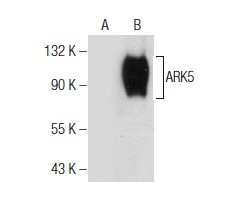
Western blot analysis of ARK5 expression in non-transfected: (A) and human ARK5 transfected: (B) 293T whole cell lysates.| Product Name | ARK5 Antibody (H-136) |
|---|---|
| Antibody Type | Primary Antibodies |
| Antigen Alias | epitope corresponding to amino acids 526-661 mapping at the C-terminus of ARK5 of human origin |
| Modification Notes | 5’-AMP-activated protein kinase, known as AMPK, is a heterotrimeric complex that protects cells from stresses that cause ATP depletion by switching off ATP-consuming biosynthetic pathways. Activated AMPK phosphorylates and regulates hydroxymethylglutaryl-CoA reductase and acetyl-CoA carboxylase, which are key regulatory enzymes of sterol synthesis and fatty acid synthesis, respectively. The AMPK-related kinase 5 (ARK5) is a tumor progression-associated factor that is directly phosphorylated by Akt at Ser 600, which is in its regulatory domain. NDR2, a serine/threonine protein kinase, phosphorylates and activates ARK5 during Insulin-like growth factor (IGF)-I signaling in order to promote cell survival. This activation may be involved in the invasion of colorectal cancer cell lines. Furthermore, ARK5 is a transcriptional target of the Large-MAF family and may have a role in mediating the aggressiveness of c-Maf- and MafB-expressing myelomas. |
| Clonality | Polyclonal |
|---|---|
| Isotype | IgG |
| Host Species | Rabbit |
| Tested Applications | WBIPIFELISA |
| recommended for detection of ARK5 of human origin and Nuak1 of mouse and rat origin by WB, IP, IF and ELISA also reactive with additional species, including equine, canine, bovine and porcine: |
|
| Species Reactivity | HumanMouseRat |
| Concentration | 1mg/ml |
| Purification | Affinity purified |
| Alternative Names | epitope corresponding to amino acids 526-661 mapping at the C-terminus of ARK5 of human origin |
|---|---|
| Tissue Specificity | epitope corresponding to amino acids 526-661 mapping at the C-terminus of ARK5 of human origin |
Application
Western blot analysis of ARK5 expression in non-transfected: (A) and human ARK5 transfected: (B) 293T whole cell lysates.| Application Notes | recommended for detection of ARK5 of human origin and Nuak1 of mouse and rat origin by WB, IP, IF and ELISA also reactive with additional species, including equine, canine, bovine and porcine: |
|---|
| Form | Liquid |
|---|---|
| Storage Instructions | For short-term storage, store at 4° C. For long-term storage, aliquot and store at -20ºC or below. Avoid multiple freeze-thaw cycles. |
| Storage Buffer | phosphate buffered saline , pH 7.4, 150mM NaCl, 0.02% sodium azide and 50% glycerol. |


