Application
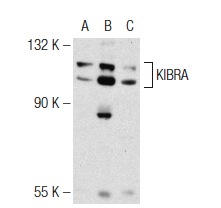
Western blot analysis of KIBRA expression in MCF7 (A), IMR-32 (B) and ZR-75-1 (C) whole cell lysates.| Product Name | KIBRA Antibody (T-12) |
|---|---|
| Antibody Type | Primary Antibodies |
| Modification Notes | KIBRA (kidney and brain protein), also known as WWC1 (WW and C2 domain containing 1) or HBEBP3, is a 1,113 amino acid protein that localizes to the cytoplasm and contains one C2 domain and two WW domains. Expressed in colon, brain, kidney and heart tissue, KIBRA is thought to interact with dendrin and, via this interaction, may play a role in collagen-induced signaling. Additionally, KIBRA, which exists as multiple alternatively spliced isoforms, is involved in memory performance and in the pathogenesis of Alzheimer's disease. The gene encoding KIBRA maps to human chromosome 5, which contains 181 million base pairs and comprises nearly 6% of the human genome. Deletion of the p arm of chromosome 5 leads to Cri du chat syndrome, while deletion of the q arm or of chromosome 5 altogether is common in therapy-related acute myelogenous leukemias and myelodysplastic syndrome. |
| Clonality | Polyclonal |
|---|---|
| Isotype | IgG |
| Host Species | Rabbit |
| Tested Applications | WBIPIFELISA |
| recommended for detection of KIBRA isoforms 1 and 2 of mouse, rat and human origin by WB, IP, IF and ELISA also reactive with additional species, including bovine | |
| Species Reactivity | HumanMouseRat |
| Concentration | 1mg/ml |
| Purification | Affinity purified |
| Alternative Names | epitope mapping near the C-terminus of KIBRA of human origin |
|---|---|
| Tissue Specificity | epitope mapping near the C-terminus of KIBRA of human origin |
| Entrez Gene | 23286 |
|---|
Application
Western blot analysis of KIBRA expression in MCF7 (A), IMR-32 (B) and ZR-75-1 (C) whole cell lysates.| Application Notes | recommended for detection of KIBRA isoforms 1 and 2 of mouse, rat and human origin by WB, IP, IF and ELISA also reactive with additional species, including bovine |
|---|
| Form | Liquid |
|---|---|
| Storage Instructions | For short-term storage, store at 4° C. For long-term storage, aliquot and store at -20ºC or below. Avoid multiple freeze-thaw cycles. |
| Storage Buffer | phosphate buffered saline , pH 7.4, 150mM NaCl, 0.02% sodium azide and 50% glycerol. |


