Application
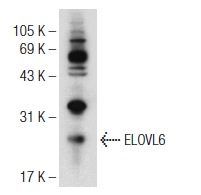
Western blot analysis of ELOVL6 expression in mouse brain tissue extract.| Product Name | ELOVL6 Antibody (H-120) |
|---|---|
| Antibody Type | Primary Antibodies |
| Antigen Alias | epitope corresponding to amino acids 1-120 mapping at the N-terminus of ELOVL6 of human origin |
| Modification Notes | Elongation of very long chain fatty acid-like (ELOVL) proteins 1-6 are members of the ELO family of proteins, which play an important role in tissue-specific biosynthesis of very long chain fatty acids and sphingolipids. The ELOVL proteins act as catalysts in fatty acid elongation reduction and localize to the endoplasmic reticulum (ER). ELOVL6 (elongation of very long chain fatty acids protein 6), also known as fatty acid elongase 2, LCE (long-chain fatty-acyl elongase), FACE (fatty acyl-CoA elongase) or FAE, is a 265 amino acid multi-pass membrane protein that localizes to endoplasmic reticulum and mitochondria. A fatty acid elongase with specificity for C12-C16 saturated and monoinsaturated fatty acids, ELOVL6 is implicated in insulin sensitivity and energy metabolism, and is therefore considered a potential target for metabolic diseases including cardiovascular disease and diabetes. |
| Clonality | Polyclonal |
|---|---|
| Isotype | IgG |
| Host Species | Rabbit |
| Tested Applications | WBIPIFELISA |
| recommended for detection of ELOVL6 of mouse, rat and human origin by WB, IP, IF and ELISA also reactive with additional species, including equine, canine, porcine and avian: |
|
| Species Reactivity | HumanMouseRat |
| Concentration | 1mg/ml |
| Purification | Affinity purified |
| Alternative Names | epitope corresponding to amino acids 1-120 mapping at the N-terminus of ELOVL6 of human origin |
|---|---|
| Tissue Specificity | epitope corresponding to amino acids 1-120 mapping at the N-terminus of ELOVL6 of human origin |
Application
Western blot analysis of ELOVL6 expression in mouse brain tissue extract.| Application Notes | recommended for detection of ELOVL6 of mouse, rat and human origin by WB, IP, IF and ELISA also reactive with additional species, including equine, canine, porcine and avian: |
|---|
| Form | Liquid |
|---|---|
| Storage Instructions | For short-term storage, store at 4° C. For long-term storage, aliquot and store at -20ºC or below. Avoid multiple freeze-thaw cycles. |
| Storage Buffer | phosphate buffered saline , pH 7.4, 150mM NaCl, 0.02% sodium azide and 50% glycerol. |


