Application
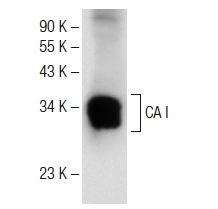
Western blot analysis of CA I expression in mouse spleen tissue extract.| Product Name | CA I Antibody (H-48) |
|---|---|
| Antibody Type | Primary Antibodies |
| Modification Notes | Carbonic anhydrases (CAs), also designated carbonate dehydratases or carbonate hydrolyases, form a large family of genes that encode zinc metalloenzymes of great physiologic importance. As catalysts of the reversible hydration of carbon dioxide, these enzymes participate in a variety of biologic processes, including respiration, acid-base balance, bone resorption and calcification as well as the formation of aqueous humor, cerebrospinal fluid, saliva and gastric acid. Genes in the å-carbonic anhydrase family encode either active carbonic anhydrase isozymes or “acatalytic” (devoid of CO2 hydration activity) carbonic anhydrase-related proteins. Human CA I (CA1) is encoded by the CA1 gene, which maps to a region on chromosome 8 that harbors a cluster of CA genes. CA I localizes to the cytoplasm and research indicates that a severe deficiency of CA I does not result in any obvious hematological or renal consequences. |
| Clonality | Polyclonal |
|---|---|
| Isotype | IgG |
| Host Species | Rabbit |
| Tested Applications | WBIPIFELISA |
| recommended for detection of CA I of mouse, rat and human origin by WB, IP, IF and ELISA also reactive with additional species, including equine, canine, bovine and porcine | |
| Species Reactivity | HumanMouseRat |
| Concentration | 1mg/ml |
| Purification | Affinity purified |
| Alternative Names | epitope corresponding to amino acids 33-80 mapping near the N-terminus of CA I of human origin |
|---|---|
| Tissue Specificity | epitope corresponding to amino acids 33-80 mapping near the N-terminus of CA I of human origin |
| Entrez Gene | 759 |
|---|
Application
Western blot analysis of CA I expression in mouse spleen tissue extract.| Application Notes | recommended for detection of CA I of mouse, rat and human origin by WB, IP, IF and ELISA also reactive with additional species, including equine, canine, bovine and porcine |
|---|
| Form | Liquid |
|---|---|
| Storage Instructions | For short-term storage, store at 4° C. For long-term storage, aliquot and store at -20ºC or below. Avoid multiple freeze-thaw cycles. |
| Storage Buffer | phosphate buffered saline , pH 7.4, 150mM NaCl, 0.02% sodium azide and 50% glycerol. |


