Application
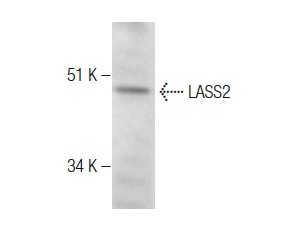
Western blot analysis of LASS2 expression in Hep G2 whole cell lysate.| Product Name | LASS2 Antibody (H-40) |
|---|---|
| Antibody Type | Primary Antibodies |
| Antigen Alias | epitope corresponding to amino acids 141-180 mapping within an internal region of LASS2 of human origin |
| Modification Notes | The LASS (longevity assurance homolog) family members are highly conserved from yeasts to mammals. Six members of this family of proteins involved in sphingolipid synthesis have been characterized (LASS1, LASS2, LASS3, LASS4, LASS5 and LASS6). LASS2 is a 380 amino acid multi-pass membrane protein expressed in kidney, liver, brain, heart, placenta and lung. LASS2 suppresses the growth of cancer cells and is involved in sphingolipid synthesis. Overproduction of LASS2 increases the levels of long ceramides such as C22:0- and C24:0-ceramides. The N-terminal asparagine residue serves as a site for glycosylation on the luminal side of the endoplasmic reticulum membrane. LASS2 interacts with several membrane-associated receptors or transporters including ASGPR1, ASGPR2 and OCT1. |
| Clonality | Polyclonal |
|---|---|
| Isotype | IgG |
| Host Species | Rabbit |
| Tested Applications | WBIPIFELISA |
| recommended for detection of LASS2 of mouse, rat and human origin by WB, IP, IF and ELISA also reactive with additional species, including equine, canine, bovine and porcine: |
|
| Species Reactivity | HumanMouseRat |
| Concentration | 1mg/ml |
| Purification | Affinity purified |
| Alternative Names | epitope corresponding to amino acids 141-180 mapping within an internal region of LASS2 of human origin |
|---|---|
| Tissue Specificity | epitope corresponding to amino acids 141-180 mapping within an internal region of LASS2 of human origin |
| Entrez Gene | 29956 |
|---|
Application
Western blot analysis of LASS2 expression in Hep G2 whole cell lysate.| Application Notes | recommended for detection of LASS2 of mouse, rat and human origin by WB, IP, IF and ELISA also reactive with additional species, including equine, canine, bovine and porcine: |
|---|
| Form | Liquid |
|---|---|
| Storage Instructions | For short-term storage, store at 4° C. For long-term storage, aliquot and store at -20ºC or below. Avoid multiple freeze-thaw cycles. |
| Storage Buffer | phosphate buffered saline , pH 7.4, 150mM NaCl, 0.02% sodium azide and 50% glycerol. |


