Application
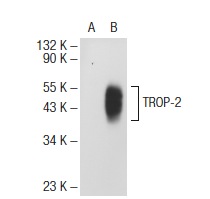
Western blot analysis of TROP-2 expression in non-transfected: (A) and human TROP-2 transfected: (B) 293T whole cell lysates.| Product Name | TROP-2 Antibody (H-85) |
|---|---|
| Antibody Type | Primary Antibodies |
| Antigen Alias | epitope corresponding to amino acids 141-225 mapping within an internal region of TROP-2 of human origin |
| Modification Notes | TROP-2, also known as tumor-associated calcium signal transducer 2 (TACSTD2), pancreatic carcinoma marker protein GA733-1, membrane component chromosome 1, surface marker 1 (M1S1) or epithelial glycoprotein-1 (EGP-1), is a cell surface glycoprotein receptor. It is a single pass type I membrane protein containing one thryoglobulin type-1 domain, an epidermal growth factor-like repeat, a phosphatidylinositol binding site and tyrosine phosphorylation sites near the C-terminus. TROP-2 plays a role in tranducing intracellular calcium signals. It is expressed in trophoblast cells, cornea and multistratified epithelia. It is also highly expressed in several types of tumors and is involved in regulating the growth of carcinoma cells. Mutations in the gene encoding TROP-2 can result in gelatinous drop-like corneal dystrophy (GDLD) also referred to as lattice corneal dystrophy type III, an autosomal recessive disorder that causes severe visual impairment. |
| Clonality | Polyclonal |
|---|---|
| Isotype | IgG |
| Host Species | Rabbit |
| Tested Applications | WBIPIFELISA |
| recommended for detection of TROP-2 of human and, to a lesser extent, mouse and rat origin by WB, IP, IF and ELISA also reactive with additional species, including porcine: |
|
| Species Reactivity | HumanMouseRat |
| Concentration | 1mg/ml |
| Purification | Affinity purified |
| Alternative Names | epitope corresponding to amino acids 141-225 mapping within an internal region of TROP-2 of human origin |
|---|---|
| Tissue Specificity | epitope corresponding to amino acids 141-225 mapping within an internal region of TROP-2 of human origin |
| Entrez Gene | 4070 |
|---|
Application
Western blot analysis of TROP-2 expression in non-transfected: (A) and human TROP-2 transfected: (B) 293T whole cell lysates.| Application Notes | recommended for detection of TROP-2 of human and, to a lesser extent, mouse and rat origin by WB, IP, IF and ELISA also reactive with additional species, including porcine: |
|---|
| Form | Liquid |
|---|---|
| Storage Instructions | For short-term storage, store at 4° C. For long-term storage, aliquot and store at -20ºC or below. Avoid multiple freeze-thaw cycles. |
| Storage Buffer | phosphate buffered saline , pH 7.4, 150mM NaCl, 0.02% sodium azide and 50% glycerol. |


