Application
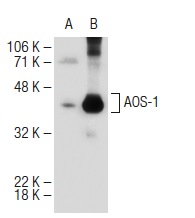
Western blot analysis of AOS-1 expression in non-transfected: (A) and human AOS-1 transfected: (B) 293 whole cell lysates.| Product Name | AOS-1 Antibody (H-207) |
|---|---|
| Antibody Type | Primary Antibodies |
| Antigen Alias | epitope corresponding to amino acids 51-257 mapping within an internal region of AOS-1 of human origin |
| Modification Notes | Proteolytic degradation by the ubiquitin (Ub) system is essential for normal cell cycle progression, cellular differentiation and stress responses. Proteins conjugated to Ub are marked for progressive degradation by the 26S Proteasome. AOS-1, also designated SUMO-1-activating enzyme or ubiquitin-like 1-activating enzyme E1A, belongs to the ubiquitin-activating E1 family of proteins and plays an important role in the first step of the UBL1 conjugation pathway. AOS-1, which is a dimeric enzyme, functions as a UBLI E1 ligase, mediating the ATP-dependent activation of UBL1. AOS-1 can bind with UBLE1A and UBLE1B to form a heterodimer which can bind UBL1. |
| Clonality | Polyclonal |
|---|---|
| Isotype | IgG |
| Host Species | Rabbit |
| Tested Applications | WBIPIFELISA |
| recommended for detection of AOS-1 of mouse, rat and human origin by WB, IP, IF and ELISA also reactive with additional species, including equine, canine, bovine and porcine: |
|
| Species Reactivity | HumanMouseRat |
| Concentration | 1mg/ml |
| Purification | Affinity purified |
| Alternative Names | epitope corresponding to amino acids 51-257 mapping within an internal region of AOS-1 of human origin |
|---|---|
| Tissue Specificity | epitope corresponding to amino acids 51-257 mapping within an internal region of AOS-1 of human origin |
Application
Western blot analysis of AOS-1 expression in non-transfected: (A) and human AOS-1 transfected: (B) 293 whole cell lysates.| Application Notes | recommended for detection of AOS-1 of mouse, rat and human origin by WB, IP, IF and ELISA also reactive with additional species, including equine, canine, bovine and porcine: |
|---|
| Form | Liquid |
|---|---|
| Storage Instructions | For short-term storage, store at 4° C. For long-term storage, aliquot and store at -20ºC or below. Avoid multiple freeze-thaw cycles. |
| Storage Buffer | phosphate buffered saline , pH 7.4, 150mM NaCl, 0.02% sodium azide and 50% glycerol. |


