Application
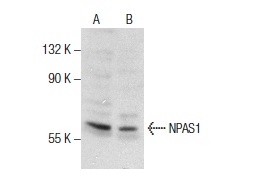
Western blot analysis of NPAS1 expression in Jurkat (A) and IMR-32 (B) nuclear extracts.| Product Name | NPAS1 Antibody (H-220) |
|---|---|
| Antibody Type | Primary Antibodies |
| Antigen Alias | epitope corresponding to amino acids 371-590 mapping at the C-terminus of NPAS1 of human origin |
| Modification Notes | Members of the bHLH-PAS family are transcription factors that contain a basic helix-loop-helix (bHLH) DNA-recognition motif which is located N-terminal to a PAS domain comprised of two imperfect direct repeats. Human NPAS1 is a deduced 590-amino acid protein which shares 86% sequence homology with mouse Npas1. In order for NPAS1 to bind DNA efficiently, it must form a dimer with another bHLH protein. NPAS1 interacts with ARNT (aryl hydrocarbon receptor nuclear translocator), and shows predominant expression in brain tissue. NPAS1 is also implicated in the control of regulatory pathways relevant to schizophrenia and to psychotic illness, and may play a role in late central nervous system development by modulating EPO expression in response to cellular oxygen levels. The NPAS1 gene maps to human chromosome 19q13.2-q13.3. |
| Clonality | Polyclonal |
|---|---|
| Isotype | IgG |
| Host Species | Rabbit |
| Tested Applications | WBIPIFELISA |
| recommended for detection of NPAS1 (Neuronal PAS domain protein 1) of mouse, rat and human origin by WB, IP, IF and ELISA also reactive with additional species, including canine: |
|
| Species Reactivity | HumanMouseRat |
| Concentration | 1mg/ml |
| Purification | Affinity purified |
| Alternative Names | epitope corresponding to amino acids 371-590 mapping at the C-terminus of NPAS1 of human origin |
|---|---|
| Tissue Specificity | epitope corresponding to amino acids 371-590 mapping at the C-terminus of NPAS1 of human origin |
Application
Western blot analysis of NPAS1 expression in Jurkat (A) and IMR-32 (B) nuclear extracts.| Application Notes | recommended for detection of NPAS1 (Neuronal PAS domain protein 1) of mouse, rat and human origin by WB, IP, IF and ELISA also reactive with additional species, including canine: |
|---|
| Form | Liquid |
|---|---|
| Storage Instructions | For short-term storage, store at 4° C. For long-term storage, aliquot and store at -20ºC or below. Avoid multiple freeze-thaw cycles. |
| Storage Buffer | phosphate buffered saline , pH 7.4, 150mM NaCl, 0.02% sodium azide and 50% glycerol. |


