Application
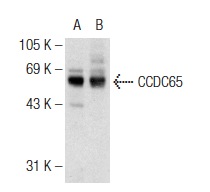
Western blot analysis of CCDC65 expression in mouse liver (A) and mouse testis (B) tissue extracts.| Product Name | CCDC65 Antibody (H-300) |
|---|---|
| Antibody Type | Primary Antibodies |
| Antigen Alias | epitope corresponding to amino acids 1-300 mapping at the N-terminus of CCDC65 of human origin |
| Modification Notes | CCDC65 (Coiled-coil domain-containing protein 65), also known as testis development protein NYD-SP28, is a 484 amino acid cytoplasmic protein that is highly expressed in spermatids, spermatocytes and spermatogonia of adult testis. Posttranslationally modified during capacitation, CCDC65 contains many potential phosphorylation sites and two potential sites each for N-glycosylation and N-myristoylation. The gene encoding CCDC65 maps to human chromosome 12, which encodes over 1,100 genes and comprises approximately 4.5% of the human genome. Chromosome 12 is associated with a variety of diseases and afflictions, including hypochondrogenesis, achondrogenesis, Kniest dysplasia, Noonan syndrome and trisomy 12p, which causes facial developmental defects and seizure disorders. There are two isoforms of CCDC65 that are produced as a result of alternative splicing events. |
| Clonality | Polyclonal |
|---|---|
| Isotype | IgG |
| Host Species | Rabbit |
| Tested Applications | WBIPIFELISA |
| recommended for detection of CCDC65 of mouse, rat and human origin by WB, IP, IF and ELISA also reactive with additional species, including canine and bovine: |
|
| Species Reactivity | HumanMouseRat |
| Concentration | 1mg/ml |
| Purification | Affinity purified |
| Alternative Names | epitope corresponding to amino acids 1-300 mapping at the N-terminus of CCDC65 of human origin |
|---|---|
| Tissue Specificity | epitope corresponding to amino acids 1-300 mapping at the N-terminus of CCDC65 of human origin |
Application
Western blot analysis of CCDC65 expression in mouse liver (A) and mouse testis (B) tissue extracts.| Application Notes | recommended for detection of CCDC65 of mouse, rat and human origin by WB, IP, IF and ELISA also reactive with additional species, including canine and bovine: |
|---|
| Form | Liquid |
|---|---|
| Storage Instructions | For short-term storage, store at 4° C. For long-term storage, aliquot and store at -20ºC or below. Avoid multiple freeze-thaw cycles. |
| Storage Buffer | phosphate buffered saline , pH 7.4, 150mM NaCl, 0.02% sodium azide and 50% glycerol. |


