Application
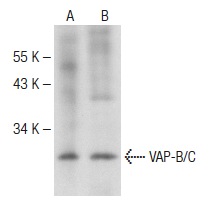
Western blot analysis of VAP-B/C expression in mouse kidney (A) and mouse liver (B) tissue extracts.| Product Name | VAP-B/C Antibody (H-40) |
|---|---|
| Antibody Type | Primary Antibodies |
| Antigen Alias | epitope corresponding to amino acids 132-170 mapping within an internal region of VAP-B/C of human origin |
| Modification Notes | SNARES are compartmentally specific, integral membrane proteins that are involved in the fusion of membranes and the transport of intracellular proteins. SNAREs are expressed at high levels in all cell types. VAMP-associated proteins (VAPs) regulate the activity of SNARES. VAP-B is a 243 amino acid protein, which consists of a conserved N-terminal domain, an alpha-helical coiled-coil domain, and a C-terminal transmembrane domain. VAP-C is a 99 amino acid protein that is a splice variant of VAP-B and retains the N-terminal 70 residues, but lacks both the coiled-coil and the transmembrane domains. Mutations in this “VAP-B/C” gene may result in amyotrophic lateral sclerosis, pinal muscular atrophy, progressive bulbar palsy, or primary lateral sclerosis. These are all motor neuron diseases, which belong to a group of neurodegenerative disorders that involve the upper and/or lower motor neurons. |
| Clonality | Polyclonal |
|---|---|
| Isotype | IgG |
| Host Species | Rabbit |
| Tested Applications | WBIPIFELISA |
| recommended for detection of VAP-B/C of human and, to a lesser extent, mouse and rat origin by WB, IP, IF and ELISA also reactive with additional species, including equine, canine, bovine and porcine: |
|
| Species Reactivity | HumanMouseRat |
| Concentration | 1mg/ml |
| Purification | Affinity purified |
| Alternative Names | epitope corresponding to amino acids 132-170 mapping within an internal region of VAP-B/C of human origin |
|---|---|
| Tissue Specificity | epitope corresponding to amino acids 132-170 mapping within an internal region of VAP-B/C of human origin |
Application
Western blot analysis of VAP-B/C expression in mouse kidney (A) and mouse liver (B) tissue extracts.| Application Notes | recommended for detection of VAP-B/C of human and, to a lesser extent, mouse and rat origin by WB, IP, IF and ELISA also reactive with additional species, including equine, canine, bovine and porcine: |
|---|
| Form | Liquid |
|---|---|
| Storage Instructions | For short-term storage, store at 4° C. For long-term storage, aliquot and store at -20ºC or below. Avoid multiple freeze-thaw cycles. |
| Storage Buffer | phosphate buffered saline , pH 7.4, 150mM NaCl, 0.02% sodium azide and 50% glycerol. |


