Application
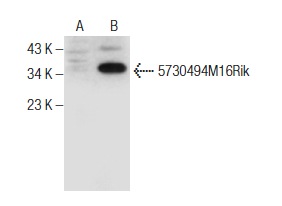
Western blot analysis of 5730494M16Rik expression in non-transfected: (A) and mouse 5730494M16Rik transfected: (B) 293T whole cell lysates.| Product Name | PGs2 Antibody (N-17) |
|---|---|
| Antibody Type | Primary Antibodies |
| Antigen Alias | epitope mapping near the N-terminus of PGs2 of human origin |
| Modification Notes | Polyglutamylation, polyglycylation and tyrosination are posttransational modifications that tubulin undergoes in order to perform at maximal function. Polyglutamylation is evolutionarily conserved from protists to mammals and is involved in several microtubule functions such as axonemal beating, stability of centrioles, neuronal differentiation and mediating the interaction between tubulin and microtubule associated proteins. The neuronal tubulin polyglutamylase is a complex that contains a TTL (tubulin tyrosine ligase-like) domain through which it catalyzes the ligation of glutamate to tubulins. The TTL domain contains ATP-grasp-like motifs that correspond to the ATP/Mg(2+) binding site typical of enzymes with ATP-dependent carboxylate-amine/thiol ligase activity. PGs2 (Tubulin polyglutamylase complex subunit 2), also known as C18orf10, is a 300 amino acid cytoplasmic protein that participates in the neuronal tubulin polyglutamylase complex, along with PGs1, PGs3, PGs4 and PGs5. There are two isoforms of PGs2 that are produced as a reslt of alternative splicing events. |
| Clonality | Polyclonal |
|---|---|
| Isotype | IgG |
| Host Species | Rabbit |
| Tested Applications | WBIPIFELISA |
| recommended for detection of PGs2 of human and rat origin, and 5730494M16Rik of mouse origin by WB, IP, IF and ELISA also reactive with additional species, including equine, canine and porcine: |
|
| Species Reactivity | HumanMouseRat |
| Concentration | 1mg/ml |
| Purification | Affinity purified |
| Alternative Names | epitope mapping near the N-terminus of PGs2 of human origin |
|---|---|
| Tissue Specificity | epitope mapping near the N-terminus of PGs2 of human origin |
| Entrez Gene | 25941 |
|---|
Application
Western blot analysis of 5730494M16Rik expression in non-transfected: (A) and mouse 5730494M16Rik transfected: (B) 293T whole cell lysates.| Application Notes | recommended for detection of PGs2 of human and rat origin, and 5730494M16Rik of mouse origin by WB, IP, IF and ELISA also reactive with additional species, including equine, canine and porcine: |
|---|
| Form | Liquid |
|---|---|
| Storage Instructions | For short-term storage, store at 4° C. For long-term storage, aliquot and store at -20ºC or below. Avoid multiple freeze-thaw cycles. |
| Storage Buffer | phosphate buffered saline , pH 7.4, 150mM NaCl, 0.02% sodium azide and 50% glycerol. |


