Application
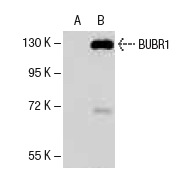
Western blot analysis of BUBR1 expression in non-transfected (A) and human BUBR1 transfected (B) 293 whole cell lysates.| Product Name | BUBR1 Antibody (H-23) |
|---|---|
| Antibody Type | Primary Antibodies |
| Antigen Alias | recommended for detection of BUBR1 of human origin by WB, IP and ELISA |
| Modification Notes | Human cells contain two related protein kinases, BUB1 and BUBR1, that appear to have evolved from a single ancestral BUB1 gene (1,2). Both kinases are concentrated near the surface of the kinetochore where they monitor kinetochore-microtubule interactions (2). BUB1 and BUBR1 bind to kinetochores and are postulated to be components of the mitotic checkpoint, which monitors kinetochore activities to determine if chromosomes have achieved alignment at the spindle equator (3). BUBR1 is essential for normal mitotic progression as it prevents cells from prematurely entering anaphase (3,4). BUB3 is a conserved component of the mitotic spindle assembly complex and is also involved with the essential spindle checkpoint pathway that operates during early embryogenesis (5,6). |
| Clonality | Polyclonal |
|---|---|
| Isotype | IgG |
| Host Species | Rabbit |
| Tested Applications | WBIPELISA |
| See 1 citations for BUBR1Antibody (H-23): |
|
| Species Reactivity | HumanMouseRat |
| Concentration | 1mg/ml |
| Purification | Affinity purified |
| Alternative Names | recommended for detection of BUBR1 of human origin by WB IP and ELISA |
|---|---|
| Tissue Specificity | recommended for detection of BUBR1 of human origin by WB, IP and ELISA |
| Entrez Gene | 701 |
|---|
Application
Western blot analysis of BUBR1 expression in non-transfected (A) and human BUBR1 transfected (B) 293 whole cell lysates.| Application Notes | See 1 citations for BUBR1Antibody (H-23): |
|---|
| Form | Liquid |
|---|---|
| Storage Instructions | For short-term storage, store at 4° C. For long-term storage, aliquot and store at -20ºC or below. Avoid multiple freeze-thaw cycles. |
| Storage Buffer | phosphate buffered saline , pH 7.4, 150mM NaCl, 0.02% sodium azide and 50% glycerol. |


